Vegan Wellington: The Dramatic Plant-Based Centrepiece
Mushroom duxelles, roasted chestnuts, and Puy lentils wrapped in golden puff pastry - the showstopper that earns its place at any table
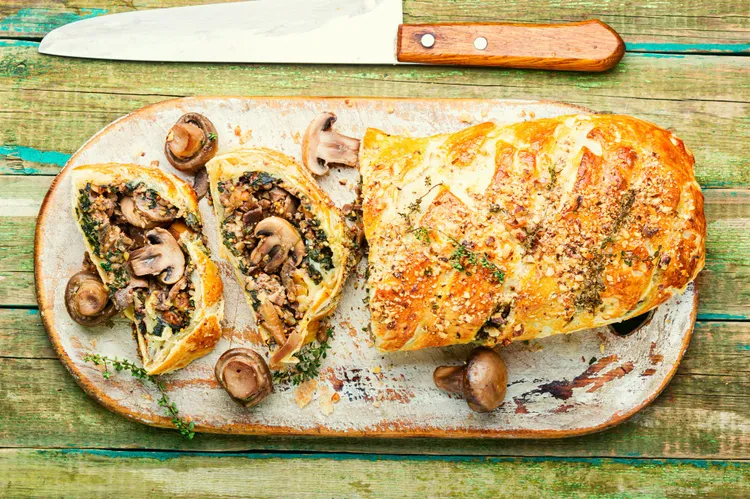
The Beef Wellington is one of the most theatrical preparations in British cooking - a seared fillet encased in mushroom duxelles and puff pastry, sliced at the table to reveal its perfectly pink interior. The Vegan Wellington works on the same theatrical principle: something genuinely impressive wrapped in golden pastry, sliced at the table, revealing a filling that has both visual drama and substantial flavour.
The difference is that the vegan version, unlike its beef counterpart, is not trying to replicate the original. This is a mushroom, chestnut, and lentil Wellington - with its own flavour identity. The mushroom duxelles provide deep umami; the roasted chestnuts bring sweetness and nuttiness; the Puy lentils bind the filling and provide protein; spinach adds colour and freshness; fresh herbs and Dijon mustard give sharpness. It is a centrepiece that earns its place at Christmas dinner, a dinner party, or a Sunday roast - not because it resembles beef Wellington but because it is genuinely excellent on its own terms.
Why This Is the Right Plant-Based Centrepiece
The challenge with plant-based cooking for occasions like Christmas is producing something that feels like a centrepiece - a dish that is the focus of the table, that gets carved or sliced with ceremony, that holds its own alongside the roasted potatoes and braised red cabbage. A bowl of curry or a plate of roasted vegetables, however good, does not function in the same ceremonial way.
The Wellington format solves this. The puff pastry creates a self-contained, architecturally impressive structure. The slicing at the table reveals a beautiful cross-section. It reheats from the oven on a platter. It scales - a longer roll serves more people. And it can be made 90% in advance, with only the final baking happening on the day.
The Components
The Mushroom Duxelles
Duxelles - finely chopped mushrooms cooked slowly in butter (here, olive oil) until completely dry - is the flavour backbone of any Wellington. Mushrooms are approximately 90% water by weight. The duxelles process removes all of that water, concentrating the mushrooms' glutamate content into a deeply savoury, almost paste-like mixture that is the most intense mushroom preparation available.
The specific technique: fine dice (not food processor - the processor makes the texture too uniform and prevents proper moisture evaporation), low-to-medium heat, patience. A 400g batch of raw mushrooms reduces to approximately 100g of concentrated duxelles in 15-20 minutes. This concentrated mixture is what prevents the Wellington's pastry from going soggy - all the moisture has already been driven off.
Mushroom variety for depth: A combination of chestnut mushrooms (the body) and dried porcini (the depth) produces a more complex duxelles than either alone. Rehydrate the dried porcini and add them, finely chopped, to the chestnut mushrooms - the soaking liquid is reserved for adding to the lentils.
The Lentil and Chestnut Filling
Puy (French green) lentils hold their shape when cooked - unlike red lentils, which collapse to a purée. This is essential for Wellington filling: it needs enough structural integrity to be sliced cleanly without the filling collapsing. Cooked Puy lentils, combined with the duxelles and roasted chestnuts, produce a filling that holds a cross-section.
Vacuum-packed cooked chestnuts are the most practical format - roasting fresh chestnuts adds significant work for the same result. Roughly chopped, they add textural contrast and a sweetness that balances the earthy mushroom depth.
Ingredients
Serves 6-8 | Active time: 45 minutes | Total time: 2 hours | Makes one 30cm Wellington
The Duxelles
- 400g chestnut mushrooms, very finely diced
- 20g dried porcini mushrooms, rehydrated in 150ml boiling water for 20 minutes, then very finely chopped (reserve the soaking liquid)
- 3 large shallots, very finely diced
- 4 garlic cloves, minced
- 3 tbsp olive oil or 30g vegan butter
- 2 tbsp fresh thyme leaves
- 2 tbsp dry sherry or white wine (optional - adds depth)
- Salt and black pepper
The Filling
- 150g Puy or green lentils (dried), cooked until just tender (20 minutes in salted water from cold - do not overcook)
- 200g cooked chestnuts (vacuum-packed), roughly chopped
- 100g baby spinach, wilted in a pan with 1 tsp olive oil, then squeezed completely dry
- 2 tbsp Dijon mustard - provides sharpness and helps the filling cohere
- 2 tbsp nutritional yeast - adds savoury, cheese-adjacent depth
- 1 tsp smoked paprika
- Salt and black pepper
The Assembly
- 2 sheets of ready-rolled all-butter puff pastry (or 500g block, rolled to 3mm) - use vegan puff pastry (most supermarket own-brand all-butter puff pastry is actually vegan; check the label for dairy)
- 2 tbsp plant-based milk (oat or soy) - for the egg-wash substitute
- 1 tsp maple syrup - mixed with the plant milk to mimic the browning of an egg wash
Method
Step 1: Make the Duxelles (can be done 2 days ahead)
Heat the olive oil in a large, wide frying pan over medium-high heat. Add the shallots - cook 5 minutes until soft and translucent. Add the garlic - cook 1 minute. Add the finely diced fresh chestnut mushrooms and rehydrated porcini.
The key technique: Spread the mushrooms as evenly as possible and resist stirring for 2-3 minutes - let the moisture evaporate from the base before stirring. The mushrooms will initially steam; continue cooking, stirring occasionally, as the moisture evaporates. After approximately 12 minutes, the mushrooms should be dry, deeply reduced, and beginning to colour.
Add the thyme, sherry or wine if using, and the reserved porcini soaking liquid (strain first through a fine cloth to remove any grit). Cook until completely dry again - another 5 minutes. Season generously. The duxelles should be intensely flavoured, almost paste-like, completely dry. Spread on a plate and refrigerate until cold.
Step 2: Make the Filling (can be done 2 days ahead)
Combine the cold duxelles with the cooked, cooled Puy lentils, roughly chopped chestnuts, squeezed-dry wilted spinach, Dijon mustard, nutritional yeast, smoked paprika, salt, and pepper. Mix thoroughly.
Check the consistency: The filling should hold together when squeezed in your hand - dense enough to be sliced cleanly. If it seems too wet, add 2-3 tbsp of breadcrumbs. If too dry, add 1 tbsp of olive oil.
Refrigerate the filling until cold. A cold filling is essential - a warm filling will melt the pastry and produce a soggy Wellington.
Step 3: Shape and chill the filling (30 minutes ahead of assembly)
Lay a large piece of cling film on the work surface. Pile the cold filling along the centre of the cling film. Shape into a log approximately 25-28cm long and 7-8cm in diameter, using the cling film to press and compact it firmly. Twist the ends of the cling film to tighten the log. Refrigerate for at least 30 minutes - ideally 2 hours. The log must hold its shape when the cling film is removed.
Step 4: Assemble (up to 24 hours ahead of baking)
Lay one sheet of puff pastry on a lightly floured surface (or on parchment). The pastry should be cold but pliable. Remove the cling film from the filling log. Place the log along the centre of the pastry, leaving 4-5cm at each short end.
Brush the edges of the pastry with the plant milk and maple syrup mixture. Fold the pastry up and over the filling, pressing to seal firmly along the seam. Fold in the ends neatly. Roll the Wellington so the seam is underneath.
Transfer to a lined baking tray, seam-side down. If using two pastry sheets, the second can be used as a decorative top layer - score with a sharp knife in a diagonal lattice pattern (do not cut all the way through).
Brush the entire surface with the plant milk and maple syrup wash. Refrigerate for at least 30 minutes - up to 24 hours. The cold rest allows the pastry to firm up and ensures even, high puff in the oven.
Step 5: Bake
Preheat the oven to 200°C (fan). Take the Wellington directly from the refrigerator to the oven - cold pastry puffs more dramatically.
Bake for 30-35 minutes until the pastry is a deep, even golden-brown all over. A pale pastry indicates under-baking - the underside will be soft and potentially doughy. The Wellington should sound hollow when tapped on the base.
Rest for 10 minutes before slicing - the filling needs to settle slightly for clean slices.
Step 6: Slice and serve
Use a sharp serrated knife for the cleanest slices - a straight-bladed knife compresses the pastry. Cut in deliberate, confident strokes at the table. Each slice should reveal a clean cross-section of golden pastry around the dark, textured filling.
The Gravy
A Wellington needs a good gravy. For the plant-based version:
Vegan red wine gravy: Sauté 1 diced onion and 2 diced shallots in olive oil until very soft and golden (10 minutes). Add 2 garlic cloves, 1 tsp fresh thyme, 1 tsp tomato paste - cook 2 minutes. Add 200ml of red wine - reduce by half. Add 500ml of good vegetable stock, 1 tbsp of soy sauce, 1 tsp of Marmite or yeast extract (provides the meaty depth that makes this gravy exceptional). Simmer 15 minutes. Make a slurry of 1 tbsp cornflour and 2 tbsp cold water - stir into the simmering gravy. Cook until thickened. Season. Strain through a fine sieve for a smooth gravy.
Make-Ahead Strategy
2 days ahead: Make the duxelles. Make the filling. Refrigerate both.
1 day ahead: Shape the filling log. Assemble the Wellington. Refrigerate the unbaked Wellington overnight - this produces the best puff and the most reliable result.
Day of: Bake from cold. Rest. Slice at the table. Make the gravy - it keeps warm in a heatproof jug.
The make-ahead assembly is one of the Wellington's greatest advantages as a dinner party or Christmas dish: the theatrical moment at the table (the baking, the presenting, the slicing) requires only 35 minutes of oven time from a completely prepared dish.
Serving
For Christmas dinner: Serve alongside The Best Roast Potatoes, Braised Red Cabbage, Brussels Sprouts with Chestnuts, and the vegan red wine gravy above. The Wellington is the centrepiece; the sides are the same as for the meat-based Christmas table.
For a dinner party: Serve with a warm grain salad (farro or barley with roasted vegetables) and a sharp green salad with mustard vinaigrette.
For a Sunday roast: Roasted seasonal vegetables, dauphinoise-style potato gratin (using plant milk and vegan butter), and the gravy.
Variations
Wild Mushroom and Walnut Wellington
Replace the chestnut mushrooms with a mixture of wild mushrooms (chanterelles, ceps, shiitake). Replace the chestnuts with toasted walnuts, roughly chopped. The wild mushroom combination has a more intensely savoury, less sweet flavour profile - excellent in autumn.
Roasted Red Pepper and Pesto Wellington
Replace the spinach with strips of roasted red pepper. Add 3 tbsp of vegan pesto (see Plant-Based Comfort Food Toolkit) to the filling. The sweeter, Mediterranean character of this version works well year-round.
Individual Mini Wellingtons
Divide the filling into 8 equal portions. Shape each into a small log. Wrap individually in smaller pastry rectangles. Serve 1-2 per person. The individual format is particularly elegant for a dinner party - each guest receives their own whole Wellington, unsliced, to cut at their own plate.
Pro Tips
- The drying of the duxelles is non-negotiable. Any residual moisture in the mushroom filling will soften the pastry from the inside during baking, producing the dreaded soggy-bottomed Wellington. The duxelles must be completely, thoroughly dry before assembly - dry enough that pressing it between your fingers leaves no moisture.
- Cold at every stage. Cold filling + cold assembled Wellington + cold pastry in the oven = maximum puff, crispest pastry, best structure. Any stage where warmth enters the pastry layers compromises the final result.
- The plant-milk and maple syrup wash. The maple syrup adds the sugars that produce the Maillard browning that egg would otherwise provide. Do not skip it - a pastry washed with plain plant milk will be pale and dull compared to one that has been glazed with the maple syrup mixture.
- Use a sharp serrated knife. The mechanical advantage of the serrated blade cuts through the pastry without crushing it. A straight-bladed knife, pressed down on puff pastry, compresses the layers rather than cutting them.
The Soggy Bottom Problem The single most common Wellington failure - soggy pastry on the underside. Three causes: wet filling (the duxelles were not dried thoroughly enough), warm filling (the assembled Wellington was not sufficiently chilled before baking), or underbaking (the base didn't get enough heat). Use a preheated baking tray (slide the Wellington on its parchment onto the preheated tray from the cold oven shelf) for maximum base heat, ensure the filling is dry and cold, and bake until the base sounds hollow.
FAQ
Q: Is most puff pastry vegan?
Yes - most supermarket own-brand ready-rolled puff pastry is made with vegetable fat rather than butter, making it accidentally vegan. Check the ingredients: if it says "butter puff pastry," it contains dairy. If it says "puff pastry" without butter specified, it is typically vegan. Jus-Rol and most supermarket own-brand plain puff pastry are vegan; Jus-Rol "all-butter" puff pastry is not.
Q: Can I freeze the Wellington?
Yes - freeze the fully assembled but unbaked Wellington. Wrap tightly in cling film then foil. Freeze for up to 1 month. Bake directly from frozen at 180°C for 50-60 minutes until deep golden and heated through. Do not thaw first - this produces the best result for frozen Wellingtons.
Q: Can I prepare the filling ahead and freeze it?
Yes - the filling (duxelles mixed with lentils, chestnuts, and spinach) freezes well. Thaw completely in the refrigerator before using. Ensure it is cold before assembly.
🔗 More Plant-Based Centrepieces
Latest