How to Sharpen a Knife: Whetstones, Honing Rods, and What Actually Works
The distinction most cooks confuse, the two tools that cover all your needs, and the technique that produces a genuinely sharp edge
A sharp knife is the most fundamental tool in a home kitchen - more fundamental than any individual pan, gadget, or appliance. A sharp knife requires less force, produces cleaner cuts, and is significantly safer than a dull one because controlled cuts are safer than forced, slipping cuts. Yet most home cooks have never sharpened a knife properly, and many don't know the difference between sharpening (which removes metal) and honing (which doesn't).
This guide covers both, clearly. It explains what happens to a knife edge over time, why the two maintenance approaches are different and when each is needed, the specific techniques that produce a genuinely sharp edge, and the tools that actually deliver versus the ones that disappoint.
What Happens to a Knife Edge
A chef's knife blade tapers to a V-shaped edge - two flat surfaces (bevels) meeting at an angle of approximately 15-20° per side (European/German knives) or 10-15° per side (Japanese knives). This edge is what cuts.
Two forms of degradation:
Micro-bending (rolling): With regular use, the very tip of the edge bends microscopically to one side or the other - like a thin metal strip being pushed sideways. The edge is still present but misaligned; the knife feels noticeably less sharp but the edge itself hasn't been removed. This is what honing corrects.
Micro-chipping (blunting): With extended use and harder cutting tasks, small sections of the edge chip away or wear down - the edge is genuinely missing material, not merely misaligned. This is what sharpening corrects.
The practical implication: a knife that was sharp and has become less sharp after regular use usually needs honing, not sharpening. A knife that was honed and still doesn't feel sharp needs sharpening.
Honing: The Regular Maintenance
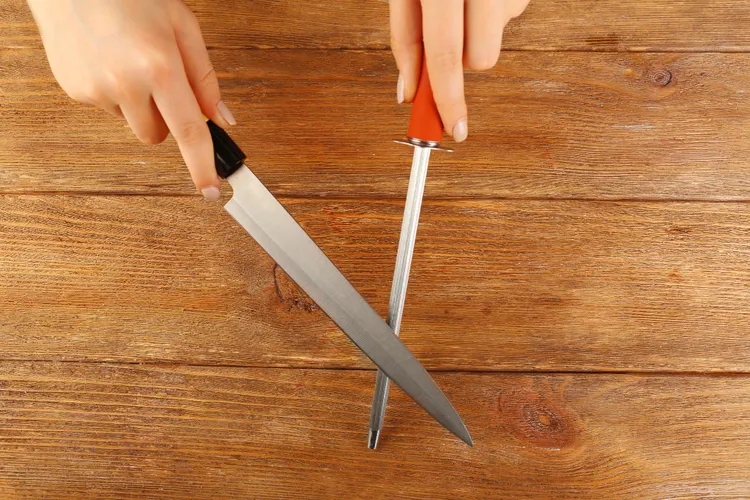
Honing realigns a bent edge without removing metal. It is done with a honing rod (also called a honing steel, sharpening steel - confusingly, since it doesn't sharpen).
When to hone: Before every significant cutting session. Takes 30-60 seconds. This single habit extends the time between sharpening sessions significantly and keeps the knife performing at close to its best consistently.
The honing rod options:
Smooth steel rod: The traditional tool. Realigns the edge by straightening the bent metal. Works best on soft European steel (Wüsthof, Henckels). Less effective on harder Japanese steel.
Ridged steel rod: Has fine ridges along the length. Slightly more aggressive than smooth - it realigns and lightly abrades the edge simultaneously. Suitable for European steel.
Ceramic rod: More aggressive than steel rods - it removes a very small amount of metal while realigning. The best tool for both European and Japanese knives. Looks like a white or grey rod, typically finer than a steel rod.
Diamond rod: The most aggressive honing tool - removes noticeable metal. Used for quick in-between maintenance on very dull knives, not for regular honing.
Recommendation: A smooth or ridged steel rod for a European knife, a ceramic rod for a Japanese knife. A ceramic rod works well on both.
The Honing Technique
Method 1 - Stationary rod (the more controlled approach):
- Hold the rod vertically, tip resting firmly on the cutting board
- Hold the knife with the pinch grip, blade at 15-20° from the rod (European knife) or 10-15° (Japanese knife)
- Starting with the heel of the blade at the top of the rod, draw the knife downward and toward you simultaneously - heel to tip traces a smooth arc from the top to the bottom of the rod
- Maintain constant angle throughout the stroke
- Alternate sides - 5-10 strokes per side
Method 2 - Moving rod (the faster approach):
Hold the knife stationary and draw the rod across the blade at the correct angle. Both methods produce the same result; the stationary rod gives beginners more control.
The angle: The correct angle is the most important variable. Too steep (45°): you are rounding the edge, not aligning it. Too shallow (5°): the rod isn't engaging the edge. 15-20° is approximately the angle of a credit card laid flat - roughly 15° from the surface.
Sharpening: The Periodic Restoration
Sharpening removes metal from the blade's bevels to create a new, aligned edge. It is done with an abrasive surface - a whetstone (the best method), a pull-through sharpener (the most convenient), or a professional sharpening service (the easiest).
When to sharpen: When honing no longer restores sharpness - typically every 3-6 months for a regularly used home knife. If the knife still fails the paper test (see below) after honing, it needs sharpening.
The Whetstone Method
A whetstone (also called a sharpening stone or waterstone) is the most effective and most controllable home sharpening method. It removes metal precisely and consistently when used correctly. It produces a better edge than any other home method and is the method used by professional knife sharpeners.
Whetstone grits:
- 200-400 grit (coarse): For repairing chipped or very dull blades - removes metal quickly. Not needed unless the blade is damaged.
- 800-1000 grit (medium): The primary sharpening grit. Removes metal and begins to form the new edge. Use this first.
- 2000-3000 grit (fine): Refines the edge produced by the coarser grit - smooths the micro-scratches and begins polishing the bevel.
- 6000-8000 grit (very fine/finishing): Produces a polished, very sharp edge. Many home sharpeners use a 1000/6000 combination stone.
The technique:
Step 1 - Soak the stone. Most whetstones (waterstones) require soaking in water for 5-10 minutes before use. Check your stone's instructions - some are splash-and-go. Dry stones (oil stones) require a few drops of honing oil rather than water.
Step 2 - Find the bevel angle. Lay the knife flat on the stone. This is 0°. Raise the spine of the blade until you can just fit two or three stacked coins under the spine - this is approximately the correct angle (15-20° for European knives, 10-15° for Japanese). Maintaining this angle consistently throughout sharpening is the most important and most difficult variable.
Step 3 - Sharpen the first side. Place the heel of the blade at the far end of the stone. Push the blade forward across the stone while simultaneously drawing it toward you - a motion that traces the full length of the edge across the stone's surface in a single stroke (heel to tip moves across the stone in one motion). Apply moderate, consistent pressure. The pressure should come from the spine hand - the other hand's fingertips on the flat of the blade near the edge can feel whether the angle is being maintained.
Repetitions: 10-15 strokes on one side before switching.
Step 4 - Check for the burr. After 10-15 strokes on side 1, run your thumb gently across the back of the blade (not along the edge). You should feel a slight roughness or burr - a tiny curl of metal that has been pushed up by the stone. The burr indicates the stone has worked through to the very edge. If no burr: continue sharpening.
Step 5 - Sharpen the second side. Flip the knife and sharpen the other side until a burr forms on the back of that side too.
Step 6 - Alternate strokes to remove the burr. 5 alternating strokes per side (one stroke on one side, one on the other, alternating) at lighter pressure. This removes the burr without forming it on the other side.
Step 7 - Refine with finer grit. If using a two-grit stone, repeat the process on the finer grit (6000-8000): 5-8 strokes per side, alternating, very light pressure. This polishes the bevel and sharpens the edge.
Step 8 - Hone on the ceramic rod to realign any remaining burr and align the final edge. 5 strokes per side.
Step 9 - Test. See below.
Pull-Through Sharpeners: The Convenient Alternative
Pull-through sharpeners have pre-set angle guides that remove the need to maintain an angle manually. They are significantly faster than whetstones and produce acceptable results on European knives.
The drawbacks:
- Remove more metal per session than a whetstone - the knife wears out faster
- Cannot sharpen Japanese knives safely (too aggressive, wrong angle)
- Produce a coarser, less refined edge than a whetstone
- Cannot repair chipped or very damaged blades
Best use case: European knives in a home kitchen where the owner doesn't want to learn the whetstone technique. Acceptable results with minimal skill requirement.
Not recommended for: Japanese knives, expensive European knives where longevity matters, any blade with a chip or significant damage.
Professional Sharpening: The Easiest Option
Many kitchen equipment shops and knife specialists offer professional sharpening at £2-8 per knife. A professional sharpening service produces an excellent edge, extends knife life by removing metal correctly, and handles damaged blades that a home whetstone can't easily fix.
Recommended approach: Sharpen professionally once or twice a year, and hone at home before every session. This combines the best edge quality with the convenience of minimal home maintenance.
Sharpness Tests
The paper test: Hold a sheet of printer paper by the top edge. Draw the knife edge downward through the paper. A sharp knife cuts through cleanly without tearing. A dull knife tears or skips rather than cutting. A very sharp knife cuts through with no resistance at all.
The tomato test: A sharp knife cuts through a tomato's skin with light pressure and no sawing motion. A dull knife compresses and slips across the skin before eventually cutting through. The tomato test is the most practical, real-world sharpness indicator.
The fingernail test: Gently rest the edge (don't slide it) on your thumbnail at approximately 45°. A sharp edge bites and stays - it doesn't slip or slide across the nail. A dull edge slides. Don't apply pressure - this is a contact test, not a pressure test.
Sharpening Angles by Knife Type
| Knife Type | Bevel Angle Per Side | Notes |
|---|---|---|
| German/European chef's knife | 15-20° | Softer steel, more forgiving |
| Japanese chef's knife | 10-15° | Harder, more brittle steel |
| Santoku | 10-15° | |
| Paring knife | 15° | |
| Bread knife (serrated) | Do not sharpen at home | Professional sharpening only |
| Cleaver | 20-25° | Thicker bevel for durability |
Serrated knives: Cannot be sharpened at home with a whetstone. A professional can sharpen each serration individually. In practice, serrated bread knives last for years without sharpening because each tooth maintains a sharp point; when they dull, professional sharpening or replacement is the solution.
Pro Tips
- Hone before every session, sharpen rarely. Daily or near-daily honing keeps the edge aligned and greatly extends the time between sharpening sessions. Most knives that "have gone dull" need honing, not sharpening.
- Consistent angle is everything on a whetstone. The most common whetstone error is allowing the angle to shift during the stroke - the stone is sharpening different parts of the bevel, never creating a consistent new edge. Slow, controlled strokes at a maintained angle produce better results than fast, loose ones.
- A sharp knife requires less force and is safer. The paradox of sharp knives: they seem more dangerous but they are not. A dull knife requires significant force; when that force causes the knife to slip, the injury risk is high. A sharp knife cuts with minimal force applied - it guides itself through the food.
- Dry the knife before storing. Moisture causes oxidation on carbon steel knives and can damage handles over time. Wipe dry immediately after washing and before storing.
The Distinction That Matters: Honing Is Not Sharpening A honing rod does not sharpen - it does not remove metal. It realigns a bent edge. This means: if your knife is genuinely dull (the edge has worn away or chipped, not merely bent), honing will not fix it. The paper test tells you which problem you have: if the knife cuts paper cleanly after honing, the problem was edge misalignment (honing fixed it). If it still tears paper after honing, the edge needs metal removed (it needs sharpening). Many home cooks have honing rods and no sharpening tool, producing knives that are partially maintained but never fully restored.
FAQ
Q: How do I know which angle my knife was originally sharpened to?
German/European knives are typically factory-sharpened to 15-20° per side. Japanese knives to 10-15° per side. If you bought a secondhand knife or don't know its history, shine a torch at the edge and look at the width of the bevel - a narrow bevel indicates a shallower angle. When in doubt, use 15° - it's a safe middle ground for most knives.
Q: Can I use the whetstone wet or should I oil it?
Most modern whetstones are waterstones - use water. A few drops before sharpening, more during as the surface dries. Oil stones require honing oil. Do not use water on an oil stone or oil on a waterstone - you'll damage the stone. Check the manufacturer's recommendation.
Q: My whetstone is developing grooves. Is that normal?
Yes - the stone wears as metal is removed from the knife. Grooves reduce the stone's effectiveness because they no longer present a flat sharpening surface. Flatten a grooved stone by rubbing it on a flat surface with abrasive (wet-dry sandpaper on a glass plate, or a dedicated stone flattener). A flat stone produces consistent results; a grooved one doesn't.
🔗 Continue Building Skills
Latest