How to Hold and Use a Chef's Knife: The Foundation of Everything
The pinch grip, the claw, rocking vs. push-cutting, and why 20 minutes of technique changes every hour you spend in the kitchen
Most home cooks have never been taught how to hold a knife. They grip the handle - the entire handle, with the thumb resting on the side of the handle or tucked beside it - and proceed to cut, chop, and slice. This grip works, in the sense that the knife cuts food. But it lacks the control, the efficiency, and the safety of the correct technique, and every hour spent cooking with a poor grip is an hour reinforcing a habit that makes cooking slower and more effortful than it needs to be.
The correct technique takes approximately 20 minutes to learn and feel unnatural for about a week. After that week, it becomes automatic - and every subsequent hour in the kitchen is faster, more precise, and safer than before. The knife grip is the highest return-on-investment cooking skill available.
This guide covers the grip, the guiding hand, the cutting motions, the parts of the blade and what each is for, and how the correct technique on a sharp knife makes the most common kitchen preparations - dicing onions, slicing herbs, breaking down a chicken - faster, more consistent, and more controlled than they have ever been.
First: The Knife Itself
Before grip and technique: a brief note on the tool, because technique applied to the wrong knife or a dull knife produces limited results.
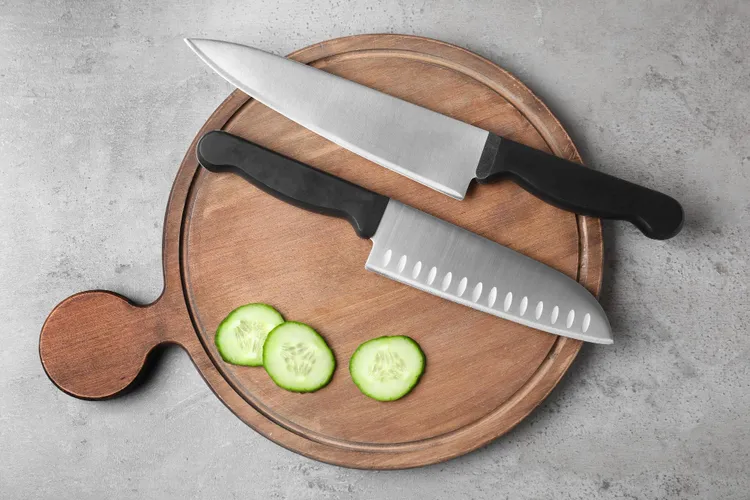
Chef's knife (also: cook's knife, French knife): The all-purpose blade that handles 90% of kitchen cutting tasks. Typically 20-25cm (8-10 inches) long. Available in two primary traditions:
German style (Wüsthof, Henckels, Victorinox): Heavier, with a slight curve from heel to tip that suits the rocking cutting motion. More forgiving on hard vegetables. Excellent all-purpose blade.
Japanese style (Global, Kai Shun, MAC): Lighter, harder steel, with a flatter blade profile that suits the push-cut or chop. Holds an edge longer but is more brittle - more susceptible to chipping on hard foods. Requires more careful sharpening.
Both traditions produce excellent knives. The best knife is the one that fits your hand - pick it up before buying. A good entry-level knife (Victorinox Fibrox Pro, approximately £30-40) performs comparably to knives costing ten times more in practical kitchen use.
Sharpness: A dull knife requires more force, slips more readily, and produces less consistent cuts than a sharp knife. Every technique in this guide assumes a sharp knife. See How to Sharpen a Knife for the complete sharpening and honing guide.
The Pinch Grip: The Foundational Hold
The pinch grip is the correct way to hold a chef's knife. It is the grip used by every professional cook and every competent home cook. It feels unfamiliar the first time; it feels natural and indispensable by the second week.
The grip:
- Extend your index finger and thumb toward the blade
- Pinch the blade itself - the flat of the blade between the thumb pad and the side of the bent index finger - at the point where the blade meets the handle (the bolster, if the knife has one)
- The remaining three fingers wrap around the handle naturally
What this achieves:
Control: By gripping the blade rather than only the handle, the hand is closer to the cutting edge. The lever-arm between the hand and the tip of the knife is shorter, producing more precise directional control. A handle-only grip feels like steering a long oar; the pinch grip feels like using a precise tool.
Balance: The knife is balanced at the pinch point - the weight is roughly equal forward and back from the grip. The knife feels lighter and more manoeuvrable than with a handle-only grip.
Stability: The blade between the fingers prevents rotation. A handle-only grip allows the knife to rotate slightly with each cut; the pinch grip locks the blade's orientation against the fingers.
Practise this: Grip the knife incorrectly (handle only), then correctly (pinch grip), and move each hand through the air. The difference in control and the difference in where the fulcrum of the knife feels centred will be immediately apparent.
The Claw: The Guiding Hand
The guiding hand - the hand that holds the food - is as important as the knife hand. The claw is the safe, efficient position for the guiding hand during any cutting task.
The claw:
- Place the food on the cutting board
- Place your guiding hand on top of the food
- Curl your fingers inward so the fingertips tuck behind the first knuckle
- The flat of the blade rests against the vertical face of the knuckles as it cuts - the knuckles guide the blade like a rail
- The fingertips are behind the knuckles and protected
What the claw achieves:
Safety: The blade always rests against the knuckle face. As long as the blade stays in contact with the knuckles, the fingertips are protected. Kitchen knife injuries almost always occur when this contact is lost - when the blade skips off the food or when the guiding hand relaxes.
Control over cut width: By moving the guiding hand backward in small, precise increments after each cut, the knuckles guide the blade at a specific width - producing consistent slice thickness without measuring. Consistent slices cook uniformly; inconsistent ones don't.
The walking movement: As you cut, the guiding hand "walks" backward - a small, regular increment after each cut, keeping the knuckles in contact with the blade throughout. This rhythmic backward walk is the physical basis of efficient, consistent cutting.
The Two Cutting Motions
Different cutting tasks suit different blade motions. The two primary motions are the rock and the push-cut.
The Rock (Rocking Motion)
The motion: The tip of the knife stays in contact with the cutting board throughout. The heel of the blade raises and lowers, rocking around the fixed tip, producing a chopping motion that cuts through the food.
Best for:
- Herbs (rapid rock-chopping minces herbs quickly)
- Garlic (the crushing + rocking combination)
- Rough chopping of vegetables
- Any task where speed matters more than precision
German-style knives (with their curved blade profile) are specifically designed for the rocking motion - the curve allows the blade to rock smoothly through a full range of motion.
Technique: Place the tip of the knife on the board forward of the food. Keep it there throughout. Raise the heel and bring it down through the food in a smooth arc, using the knuckles of the guiding hand to control the width of each cut.
The Push-Cut (Forward Slice)
The motion: The blade moves forward and slightly downward simultaneously - a slicing motion rather than a chopping motion. The knife does not rock; it moves in a single direction.
Best for:
- Precise slices (tomatoes, cucumbers, fish)
- Julienne and brunoise cuts requiring consistent thickness
- Any task where precision matters more than speed
- Japanese-style knives with flat blade profiles
Technique: Position the blade with the heel behind the food. Draw the knife forward through the food while maintaining gentle downward pressure. The forward motion produces a slicing action that separates fibres rather than crushing them - this is why the push-cut is better for delicate foods (tomatoes, fish) that would be compressed and damaged by a rocking chop.
The Draw (Pull-Cut)
Used for specific tasks - carving cooked meat, cutting bread, fileting fish. The knife draws backward through the food (heel to tip direction) rather than pushing forward. Uses the saw-like action of the blade edge against protein fibres or bread crust.
The Parts of the Blade and When to Use Each
A chef's knife is not a single cutting surface - different parts of the blade are optimised for different tasks.
The tip (first 5cm): The most precise, most manoeuvrable part of the blade. Use for: delicate work, making precise small cuts, scoring, creating the radial cuts in an onion dice (where precision near the root is needed). The tip can be used with the rocking motion or with a push-cut.
The mid-blade: The main workhorse. Used for most slicing and chopping tasks - the onion dice, the carrot slice, the herb chop. The widest part of the blade provides the most cutting area and the most clearance between the hand and the board.
The heel: The thickest, most sturdy part of the blade. Use for: hard vegetables (squash, root vegetables, celery root), cutting through bones (small ones - never try to cut through a large bone), tasks requiring more force. The heel is furthest from the tip and closest to the handle - it provides the most leverage.
The flat of the blade: Use for: crushing garlic (place the flat on the garlic, press with the heel of your free hand to crush), transferring chopped ingredients from the board to the pan, smashing lemongrass (see Lemongrass post).
The Board: The Third Element
A stable, appropriately sized cutting board is as important as the knife technique. A board that moves, is too small, or has the wrong surface makes good knife technique significantly harder.
Material:
- Wood (end-grain preferred): The best surface for knife longevity - end-grain wood fibres absorb the blade edge rather than resisting it, producing less micro-damage per cut. Heavy, stable, requires occasional oiling.
- Plastic: Easier to sanitise, dishwasher-safe. Produces slightly more blade wear than wood. Acceptable.
- Glass, ceramic, or stone: Avoid entirely - these surfaces damage knife edges very rapidly. No professional cook uses glass cutting boards.
Stability: Place a damp cloth or damp paper towel under the board before cutting. A moving board is dangerous and disrupts the rhythm of efficient cutting. This takes five seconds and eliminates a significant safety and efficiency hazard.
Size: Bigger is better - a large board allows ingredients to be pushed to one side while the next ingredient is being prepared. Minimum: 40×30cm for a home kitchen.
The Five Most Common Techniques
1. Slicing Onions
Halve the onion through the root. Place flat side down. Claw the top. Slice across or with the grain using the rocking or push-cut motion. See How to Dice an Onion Properly for the complete guide.
2. Mincing Garlic
Peel. Crush with the flat of the blade - place the blade flat on the garlic and press firmly with the heel of your free hand. The crushed garlic is now easy to mince: use the rocking motion repeatedly, rotating the pile 90° between passes, until very fine.
3. Slicing Herbs (Chiffonade)
Stack the herb leaves (basil, mint, sage) and roll into a tight cylinder. Slice across the cylinder with the push-cut motion to produce fine ribbons. See 5 Essential Knife Cuts for the full chiffonade and other cut techniques.
4. Breaking Down a Whole Chicken
A task where the knife's different sections earn their distinction: the tip for the joints (insert at the joint, locate the gap between bones, cut through cartilage not bone), the heel for the backbone. See the How to Sear Meat post for spatchcocking.
5. Julienne Vegetables
Slice vegetables into planks of consistent thickness (2–3mm). Stack the planks. Slice into matchsticks (2–3mm wide). This is push-cut work - precision matters more than speed.
Building Speed
Speed in knife work is a byproduct of correct technique, not a goal in itself. A cook with correct grip and claw technique who cuts at a measured pace is faster than a cook with incorrect technique who cuts quickly - because the correct technique produces consistent cuts on the first attempt rather than requiring corrections and re-cuts.
The sequence for building speed:
- Learn the correct grip and claw - 20 minutes of focused practice
- Apply them slowly and consciously for 2 weeks
- Speed develops naturally as the technique becomes automatic
- Never sacrifice accuracy for speed - a 3mm slice cut at 60% of maximum speed is more valuable than a variable-thickness slice cut at 100% speed
Pro Tips
- The pinch grip feels unnatural for exactly one week. Every cook who learns it reports the same experience: it feels awkward and slightly precarious for the first week, then becomes the only grip that feels right. Trust the process.
- Look at where the knife is going, not where it just was. Eyes forward - at the cut you are about to make, not the cut you just made. This is a safety and efficiency instruction. Where your eyes go, the cut follows.
- Wipe the blade, don't run it under the tap. Running a wet cloth along the flat of the blade (away from the edge) to clean it between tasks is faster and safer than rinsing and drying. Keep a damp cloth beside the board.
- The knife goes in the block or on the magnetic strip, never loose in a drawer. A knife loose in a drawer damages the edge against other utensils, and presents a hidden blade hazard when reaching into the drawer.
Safety Rule: The Claw Is Always Active The claw protects your fingertips from the blade by keeping them behind the knuckles. It must be maintained for every cut - not just when cutting fast or cutting large items. Kitchen knife injuries overwhelmingly occur during small, routine cuts when the guiding hand becomes casual and a fingertip extends past the knuckle. The claw is not a technique for large cuts; it is the permanent position of the guiding hand whenever a sharp knife is in use.
FAQ
Q: My knuckles are in the way when cutting thin slices. How do I manage?
As the food becomes thinner (the last few slices of an onion, the final slice of a cucumber), the knuckles naturally become more prominent relative to the remaining food. The solution: slow down, use the fingertips of the claw to press and stabilise the thin remaining piece, and make deliberate, controlled cuts. Accept that the final slice or two of any item requires more care than the middle slices.
Q: Is a heavier knife better than a lighter one?
Not universally - it depends on cutting style and hand strength. German-style heavy knives suit the rocking motion and feel authoritative on hard vegetables. Japanese-style lighter knives suit the push-cut and feel more precise for delicate work. Both are correct tools for different approaches. The best knife is the one that feels balanced and comfortable in your specific hand.
Q: How often should I hone and sharpen my knife?
Hone (realign the edge with a honing rod) before every significant cutting session - 5-10 strokes per side, takes 30 seconds. Sharpen (remove metal to create a new edge, using a whetstone or professional service) every 3-6 months for a regularly used home knife. See How to Sharpen a Knife for the complete guide.
🔗 Continue Building Skills
Latest