How to Dice an Onion Properly (Without Crying)
The step-by-step technique for the cut that appears in more recipes than any other - and the science of why onions make you cry
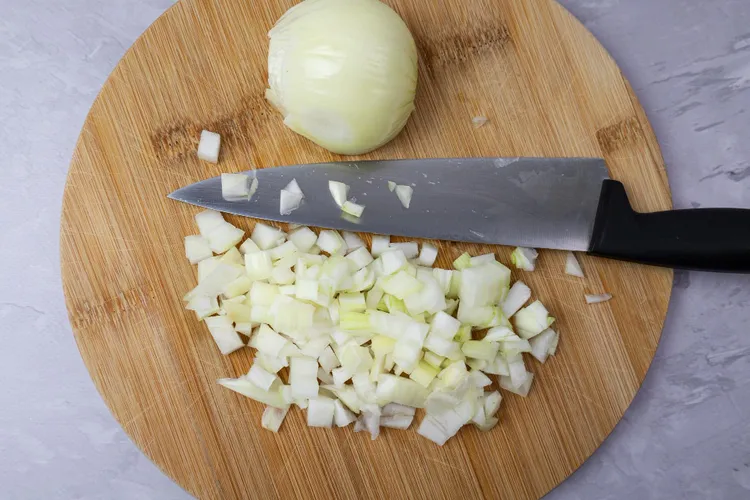
The onion dice appears in more recipes than any other single knife cut. Virtually every soup, stew, sauce, curry, braise, stir-fry, and sauté begins with a diced onion. Most home cooks perform this cut dozens of times a year - and most do it slightly wrong in ways that make it slower, less safe, and less consistent than the correct technique.
The correct technique is not difficult. It takes about 90 seconds per onion once learned. The result is even, consistent dice that cooks uniformly - not a mixture of large chunks and tiny fragments that cook at different rates. And it keeps the root end intact throughout, which is the specific structural decision that makes the whole method possible.
This guide covers the technique step by step, explains why each step exists, addresses the crying problem with the science behind it and three practical solutions, and covers the related cuts (mince, slice, chiffonade) that follow from the same foundational technique.
The Equipment
A sharp chef's knife. A dull knife is slower, less safe, and produces more ragged cuts than a sharp one. If your knife requires significant force to cut through an onion, it needs sharpening. See How to Sharpen a Knife before proceeding.
A stable cutting board. Place a damp cloth or paper towel under the board to prevent sliding - a sliding cutting board is a safety hazard and disrupts the rhythm of cutting. A large, heavy wooden or plastic board provides the most control.
The correct grip - the pinch grip: Grip the blade between the thumb and forefinger, with the thumb and forefinger pinching the blade just above the handle rather than gripping the handle alone. This produces more control and less fatigue. See How to Use a Chef's Knife for the complete knife grip and safety guide.
The claw: The hand holding the food should form a claw - fingers curled inward so the knuckles guide the blade, fingertips tucked behind. The blade slides along the knuckles, which keeps the fingers safe and regulates cut width.
The Technique: Step by Step
Step 1: Halve the onion through the root
Cut the onion in half from top to bottom - through the root end and the stem end. The cut runs from 12 o'clock to 6 o'clock, passing through the root at the bottom.
Why through the root, not across it: The root is the structural anchor of every subsequent cut. The root end holds all the layers of the onion together. If the root is cut away early, the layers separate and the onion becomes impossible to dice efficiently - each cut causes layers to fall and slide. Keeping the root intact until the very end maintains the onion as a single stable unit throughout.
Step 2: Peel
With the onion face-down (cut side on the board), peel away the papery outer skin. The outer layer often comes with it - remove this too if it is particularly dry or tough.
Step 3: Trim the stem
Cut away the stem end (the top of the onion, opposite the root) with a straight horizontal cut. Leave the root completely intact.
Step 4: Make horizontal cuts (for a fine dice)
Place the onion half flat side down on the board, root end facing away from you. Hold it with your claw hand.
Make 2-3 horizontal cuts parallel to the cutting board, stopping 1-2cm from the root end. These cuts do not go all the way through - the root holds everything together. The number of horizontal cuts determines the size of the final dice:
- Fine dice: 2-3 horizontal cuts
- Medium dice: 1-2 horizontal cuts
- Rough chop or large dice: no horizontal cuts needed (the onion layers naturally provide some horizontal separation)
Safety note: This is the most technically demanding step. Keep your claw hand firmly on the top of the onion. The cut moves toward your thumb - keep the blade parallel to the board and your hand clearly above the path of the blade. If this step is uncomfortable, it can be skipped - the dice will be slightly less fine but still very good.
Step 5: Make vertical cuts
With the onion still flat side down, make vertical cuts downward through the onion from the stem end toward the root - but not through the root. Stop 1-2cm from the root end. Space the cuts according to the dice size you want:
- Fine dice: 3-5mm apart
- Medium dice: 8-10mm apart
- Large dice: 15mm apart
The cuts should be parallel and as evenly spaced as possible.
Step 6: Dice (the final cuts)
Hold the onion firmly with your claw hand. Make horizontal cuts across the width of the onion, working from the stem end toward the root. Each cut releases a row of dice. The even spacing from the vertical cuts and the horizontal cuts produce dice of consistent, uniform size.
As you approach the root end, the cuts become smaller and the pieces less uniform. This is normal - the root end is the part that didn't get diced perfectly, and it is discarded.
Repeat on the second half.
Dice Sizes: Which to Use When
| Dice | Dimensions | Use For |
|---|---|---|
| Fine (brunoise) | 2-3mm | Sauces, dressings, raw preparations where texture matters |
| Small dice | 5-6mm | Sautéed aromatics in most recipes - the standard "diced onion" |
| Medium dice | 8-10mm | Stews, braises, soups where some onion texture remains |
| Large dice | 15mm | Slow braises, roasted vegetables, preparations with long cooking |
Most recipes that call for a "diced onion" mean small dice (5-6mm). If the recipe says "finely diced" it means 3-5mm. If it says "roughly chopped" it means large dice or irregular pieces.
The Crying Science (and What Actually Helps)
Onions make you cry through a specific chemical mechanism. When an onion cell is cut, an enzyme (alliinase) is released and reacts with compounds in adjacent cells to produce syn-propanethial-S-oxide - a volatile gas that drifts upward, reacts with the moisture in the eye, and produces sulphuric acid. The acid irritates the eye's lacrimal glands, producing tears as a protective response.
What actually reduces the effect:
1. A sharp knife. A sharp knife ruptures fewer cells per cut than a dull one - less enzyme release, less gas production. This is the most effective practical solution and a byproduct of good knife maintenance. A very sharp knife reduces eye irritation noticeably.
2. Chilling the onion. The enzyme reaction is temperature-dependent - the colder the onion, the slower the reaction. Refrigerate the onion for 30 minutes before cutting. This slows the gas production without eliminating it. Combined with a sharp knife, it significantly reduces the effect.
3. Cut near an extractor fan or open window. The gas is volatile and disperses rapidly in moving air. Positioning yourself near ventilation removes the gas before it reaches your eyes. The most reliably effective solution.
What doesn't work:
Goggles: Work perfectly - but most people don't own kitchen goggles or will wear them. Effective in principle.
Candle or match burning nearby: A persistent myth. The candle does not significantly combust the gas before it reaches your eyes. Ineffective.
Holding bread in your mouth: Folklore with no chemical mechanism. Does not work.
Running water nearby: The water needs to be between the onion and your eyes to intercept the gas - placing running water behind you accomplishes nothing. The gas rises; position yourself so it rises away from your face.
Related Cuts
Mince (Very Fine Chop)
After completing the dice, gather the diced pieces and continue chopping - rocking the knife back and forth across the pile, using the tip of the knife as a pivot point and working across the pile repeatedly until the pieces are very fine. Minced onion is used where onion flavour is wanted but visible pieces are not (dressings, some sauces, burger meat mixtures).
Slice
Across the grain (half-moon slices): Cut the onion in half through the root and stem. Place flat side down. Cut across the onion in parallel slices - these are the half-moon shaped slices used in most stir-fries and sautéed onion preparations.
With the grain (for caramelising): Cut the onion in half through the root and stem. Place flat side down. Cut along the onion from root to stem - producing long, thin strips that follow the grain of the onion. These long strips caramelise more evenly than across-the-grain slices because they have more even surface contact with the pan.
Chiffonade (For Herbs and Leafy Greens)
Not an onion cut, but the knife technique is the same. Stack herb leaves, roll into a tight cylinder, and slice across the cylinder in thin strips. The result is fine ribbons of herb - for garnishing, dressing, or adding fresh flavour.
How to Store a Partially Used Onion
Cut onion exposed to air begins to produce more of the enzyme reaction compounds - it becomes more pungent. Store cut onion in a sealed container in the refrigerator. Use within 3 days. The cut surface will oxidise slightly (turning pale and slightly translucent) - this is normal and harmless. Trim the oxidised surface before using if it bothers you.
Pro Tips
- The root end is non-negotiable. The entire efficiency of this technique depends on the root holding the onion together. The first time you practise this, cut slowly and notice how the root prevents the layers from separating. Once you experience this, you will never cut the root off again.
- Consistent cut spacing matters. Uneven spacing produces dice of different sizes that cook at different rates - the small pieces burn while the large pieces are still raw. Take the time to make the vertical cuts as evenly spaced as possible.
- The horizontal cuts can be skipped for speed. A very good dice can be produced without horizontal cuts - the natural layering of the onion provides some horizontal separation. Skip the horizontal cuts until you are comfortable with the overall technique.
- Practice on onions, not expensive ingredients. Onions are cheap and forgiving. Practise the technique until it is smooth and automatic; the knife skills transfer to every other vegetable and ingredient immediately.
The Safety Rule: Always Reform the Claw The claw - fingers curled inward so knuckles guide the blade, fingertips tucked behind - is not optional during any part of this technique. The moment a fingertip extends past the knuckle, it is in the path of the blade. Kitchen knife cuts are most common during distraction or fatigue. Keep the claw throughout. Every cut.
FAQ
Q: What size dice do most recipes mean when they say "1 onion, diced"?
Small dice - approximately 5-6mm. This produces pieces that cook through in 5-8 minutes of sautéing and disappear into the final dish. Medium dice (8-10mm) leaves more texture; fine dice (3-5mm) effectively disappears and is used when you want onion flavour without texture.
Q: Why does my onion dice always seem uneven?
Usually: the vertical cuts are not parallel (they angle toward or away from each other), or the spacing is inconsistent. Slow down the vertical cutting stage and use the claw to guide the cuts at even intervals. Even spacing produces even dice.
Q: Can I use a food processor to dice an onion?
A food processor produces chopped onion (irregular pieces) rather than dice (regular cubes). For most cooking purposes this is acceptable - the onion will cook the same way. For preparations where the size matters (classic brunoise for a sauce, or a raw diced onion salad), the food processor doesn't produce consistent enough results.
🔗 Continue Learning
Latest