Rough Puff Pastry: Layers Without the Wait
The 30-minute technique that produces three-quarters of the result of true laminated pastry - and six applications that make it essential
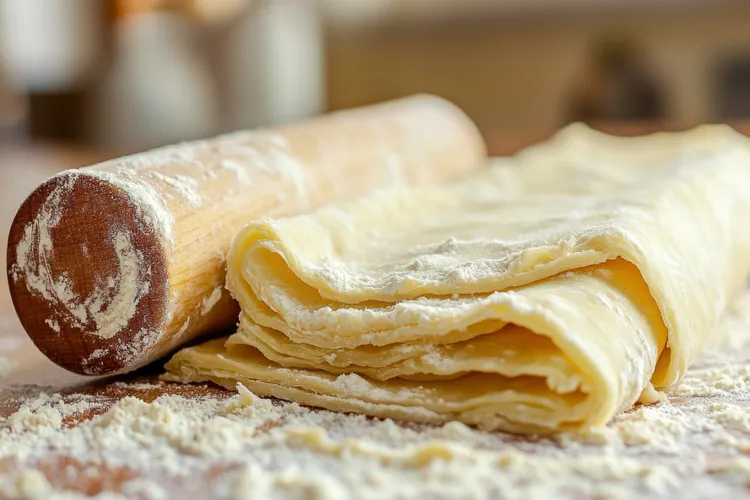
True puff pastry - the kind used in professional kitchens, in fine patisserie, in the best croissant - requires 6 "turns" (rolling and folding sequences) with 30-minute refrigerator rests between each. It takes the better part of a day. It produces approximately 729 distinct butter layers when done correctly. It is extraordinary.
Rough puff pastry takes 30 minutes and produces approximately 50-80 distinct layers. It is not the same. But it is flaky, buttery, light, and genuinely good - and for the vast majority of home cooking applications (sausage rolls, tarte tatin, cheese straws, palmiers, apple turnovers, beef Wellington), it is indistinguishable from the real thing in a completed dish.
The technique difference is this: in true puff pastry, the butter is formed into a flat block (beurrage) and layered into the dough (détrempe) as a single sheet. In rough puff pastry, the butter is added in large, irregular pieces and left partially unincorporated - producing irregular patches of butter throughout the dough that, when rolled and folded, create uneven but still numerous layers. The irregularity of the layers means rough puff is slightly less precise than true puff, but for rustic applications - sausage rolls, turnovers, tarts - it is entirely appropriate.
The Science of Layers
Both true puff and rough puff achieve flakiness through the same mechanism: butter layers that melt in the oven, releasing steam from the water content (approximately 20% of butter is water), which pushes the pastry layers apart. The more distinct butter layers, the more distinct pastry layers - and the more rise and flakiness.
Rough puff achieves this through a simpler process:
- Cold butter is mixed roughly into the flour - large pieces deliberately left intact
- Cold water brings the mixture into a dough
- Rolling and folding sequences (turns) distribute the butter into ever-thinner, more numerous layers
- The cold pastry goes into a hot oven - the butter melts, steam forms, layers separate
The cold throughout is essential. Warm butter smears into the dough rather than remaining as distinct pieces - producing an enriched dough (like shortcrust) rather than a layered one.
Ingredients
Makes 500g rough puff pastry (enough for 1 large tarte tatin or 12 sausage rolls)
- 250g plain flour, plus extra for dusting
- ½ tsp fine sea salt
- 200g unsalted butter, cold - straight from the refrigerator, cut into 2cm cubes
- 120–130ml ice-cold water
- 1 tsp lemon juice or white wine vinegar - relaxes gluten slightly, making the pastry more workable
Method
Step 1: Combine butter and flour (2 minutes)
Place the flour and salt in a large bowl. Add the cold butter cubes. Toss together briefly with your hands or a spatula.
The key distinction from shortcrust: Do not rub the butter into the flour. In shortcrust, you rub until fine crumbs form. In rough puff, you leave the butter pieces largely intact - some will flatten slightly as you toss, but most should remain as distinct, pea-to-hazelnut-sized chunks.
Step 2: Add water and form the dough (2 minutes)
Mix the lemon juice into the ice-cold water. Drizzle over the flour-butter mixture. Using a fork or knife, stir and cut until the dough just barely comes together - it should be shaggy, with visible pieces of butter throughout and bits of flour that haven't fully incorporated. It should not be smooth.
Turn out onto a lightly floured surface. Press gently into a rough rectangle - it will look terrible and barely hold together. This is correct.
Step 3: The turns (20 minutes including rests)
Turn 1: Roll the rough dough into a rectangle approximately 20×40cm. Don't worry about smooth edges - rough is fine at this stage.
Fold the bottom third up to the centre. Fold the top third down over that - like folding a letter into thirds. You now have a roughly 20×13cm rectangle with three layers.
Rotate 90° so the folded edge is to your right (like a book's spine). Wrap in cling film. Refrigerate for 10 minutes.
Turn 2: Remove from the refrigerator. Roll out again to 20×40cm. The butter pieces that were visible in the dough will be smearing into thinner patches - this is correct. Fold into thirds again. Rotate 90°. Refrigerate for 10 minutes.
Turn 3: Repeat. By now, the dough should look noticeably more cohesive and the butter less obviously chunky - it is distributing into thin layers throughout the dough.
The total: Three turns produce approximately 27 layers (3³). This is significantly fewer than true puff pastry's 729 layers after 6 turns, but it is enough for genuine flakiness in most applications.
Optional Turn 4: If time allows, a fourth turn produces noticeably more layers and a finer, more precise result. For sausage rolls and palmiers, three turns is plenty. For a tarte tatin or Wellington, four turns is better.
After the final turn, wrap and refrigerate for at least 30 minutes (up to 24 hours) before using.
Six Applications
1. Sausage Rolls (The Definitive Application)
Makes 12 | Bake at 200°C for 25 minutes
Roll 500g of rough puff pastry into a 30×40cm rectangle. Cut in half lengthways (two 15×40cm strips).
Mix 450g of good-quality pork sausage meat with 1 tsp of dried sage, 1 tsp of Dijon mustard, salt, and pepper. Divide in two. Lay each half of the sausage meat in a log along the length of each pastry strip.
Brush the long edge of each strip with beaten egg. Roll the pastry over the sausage meat and press firmly to seal. Cut each roll into 6 pieces. Score the top 3-4 times with a sharp knife. Brush all over with beaten egg.
Bake at 200°C (fan) for 25-28 minutes until deeply golden.
Why rough puff is ideal here: The irregular layers in rough puff produce a rustic, substantial, flaky exterior that is actually preferable to the more precise lamination of true puff - sausage rolls are a robust application that benefits from a heartier pastry.
2. Tarte Tatin (Apple)
Serves 6 | Bake at 200°C for 25 minutes
In a 25cm ovenproof frying pan, melt 80g of butter with 150g of caster sugar over medium heat. Cook without stirring until a dark amber caramel forms. Remove from heat.
Peel, core, and halve 6-7 eating apples. Arrange cut-side up in the caramel, packing tightly. Return to medium heat and cook for 10 minutes until the apples start to soften.
Roll the rough puff pastry into a round slightly larger than the pan. Lay over the apples, tucking the edges down around the inside of the pan.
Bake at 200°C (fan) for 25 minutes until the pastry is deeply golden. Allow to cool in the pan for 5 minutes. Place a serving plate over the pan and invert - quickly and confidently.
3. Cheese Straws
Makes 20 | Bake at 190°C for 15 minutes
Roll 500g rough puff into a 30×40cm rectangle. Sprinkle 80g of finely grated Parmesan (or Gruyère) and 1 tsp of smoked paprika over half the pastry. Fold the other half over the cheese. Roll gently to press together.
Cut into 1cm strips. Twist each strip several times. Place on a lined baking sheet, pressing the ends firmly to prevent unwinding.
Bake at 190°C (fan) for 13-15 minutes until golden and crisp.
4. Palmiers
Makes 20 | Bake at 200°C for 15 minutes
Sprinkle 100g of caster sugar over the work surface. Roll rough puff pastry into a 35×25cm rectangle over the sugar. Sprinkle the top surface generously with more sugar. Roll both long edges toward the centre, meeting in the middle. Press gently to seal. Refrigerate for 30 minutes.
Slice into 1.5cm rounds. Place on a lined sheet with space between each. Bake at 200°C (fan) for 12-15 minutes, flipping once at 8 minutes, until golden and caramelised. The caramelised sugar produces the characteristic crispy, caramelised surface.
5. Apple Turnovers
Makes 8 | Bake at 200°C for 20 minutes
Roll pastry into a 40×40cm square. Cut into 8 × 20cm squares.
Cook 4 peeled, diced apples with 50g of sugar, 1 tsp of cinnamon, and a squeeze of lemon juice until soft and thick (10 minutes). Cool.
Place a spoonful of apple filling in the centre of each pastry square. Brush the edges with beaten egg. Fold diagonally to form a triangle. Press edges firmly and crimp with a fork. Brush with egg wash. Score the top.
Bake at 200°C (fan) for 18-22 minutes until golden.
6. Rough Puff Wellington (Individual)
Wrap a seared and cooled fillet of beef (or a thick portobello mushroom and lentil wellington for a plant-based version) in prosciutto and a thin layer of duxelles (finely chopped mushroom cooked until dry). Wrap in rough puff pastry. Seal. Brush with egg wash. Refrigerate 30 minutes.
Bake at 220°C (fan) for 20-25 minutes for pink beef (internal temperature 54°C), or 30 minutes for medium. Rough puff provides excellent layering for Wellington - the more rustic layers are hidden under the egg wash glaze.
Storing Rough Puff Pastry
Refrigerator: After the final turn, the wrapped dough keeps refrigerated for up to 3 days. The flavour actually improves slightly with a longer refrigerator rest as the water distributes more evenly through the dough.
Freezer: Freeze the dough after the final turn, well-wrapped, for up to 3 months. Thaw overnight in the refrigerator. Or freeze rolled-out pastry shapes (sausage rolls, turnovers, pastry rounds) unbaked - bake directly from frozen, adding 5-10 minutes to the baking time.
Pro Tips
- Everything cold, always. If the butter begins to soften or smear during rolling, stop and refrigerate for 15 minutes. Warm butter in rough puff produces an enriched dough (like shortcrust) rather than a layered one. Temperature is the most important variable.
- Visible butter is correct. During the early turns, visible chunks and patches of butter in the dough look wrong but are exactly right. The butter distributes into layers through the rolling process - it is not supposed to be smooth or uniform from the start.
- Roll lightly, not forcefully. Heavy pressure during rolling smears the butter rather than rolling it into thin layers. Light, even pressure maintains the butter as discrete patches.
- The refrigerator rests are not negotiable. Each rest keeps the butter cold and allows the gluten to relax - both essential for a layered, non-tough result. Skipping them produces a dough that tears, sticks, and produces poor layers.
Common Mistake: Over-Rubbing the Butter Into the Flour Rough puff pastry requires large pieces of butter left deliberately intact in the dough - not the fine crumb of shortcrust. If you rub the butter until it disappears into the flour (the shortcrust habit), you have made enriched pastry, not laminated pastry. The layers are produced by the rolling and folding of large butter pieces - if those pieces don't exist in the initial mixture, no amount of turning will create them. Toss the butter with the flour; don't rub.
FAQ
Q: What is the difference between rough puff, true puff, and shortcrust?
Shortcrust: Butter fully rubbed into flour before water is added. No layers. Tender, crumbly, for tarts and pies. Rough puff: Butter partially incorporated in large pieces, then layered by rolling and folding. Moderate flakiness. For sausage rolls, turnovers, tarte tatin. True puff pastry: Butter formed into a single block and layered into the dough through 6 precise turns with 30-minute rests. Maximum flakiness, many distinct layers. For vol-au-vents, mille-feuille, precise applications.
Q: Why is my rough puff pastry not rising or flaking?
Either the butter was too warm (smeared into the dough rather than remaining as layers) or the pastry went into the oven too warm (butter melted before the oven heat could convert it to steam). Cold pastry in a very hot oven (200°C+) is what produces the rapid steam and rise. Cold dough + hot oven = flake.
🔗 Continue Baking
Latest