Shortcrust Pastry: The Foundation of Every Tart and Pie
The rub-in technique, why pastry shrinks, blind baking, and sweet shortcrust - the single technique that unlocks the most recipes
Shortcrust pastry is the most important pastry technique in this collection. Not the most dramatic - that would be croissant dough or choux. Not the most difficult - rough puff and croissant are more demanding. But shortcrust pastry is the foundation: the technique that unlocks quiches, fruit tarts, mince pies, savoury pies, lemon tart, custard tart, and the entire category of tart-and-pie baking. Get shortcrust right and an enormous range of recipes becomes accessible.
It is also the pastry most misunderstood by home bakers. Most shortcrust failures - tough pastry, shrinking pastry, pastry that falls apart - come from one of three mistakes: overworking the dough, adding too much water, or skipping the resting step. This guide explains why each of these causes problems and, more usefully, how to avoid all three.
What Makes Pastry Short
The word "short" in shortcrust refers to the pastry's texture: short pastry is tender, crumbly, and breaks with a snap rather than stretching or bending. This texture comes from the fat's role in preventing gluten development.
When cold fat is rubbed into flour until the mixture resembles fine breadcrumbs, the fat coats the individual flour particles. Coated flour particles cannot bond with each other to form gluten - the fat acts as a physical barrier. When a small amount of water is then added to bring the dough together, the gluten that does form is minimal: just enough to hold the pastry together, not enough to produce the elastic, stretchy network that characterises bread.
The result is a pastry that is tender and "short" - it crumbles rather than stretches. The more thoroughly the fat coats the flour (and the less the dough is worked after the water is added), the shorter, more tender the pastry.
This is why:
- Cold fat is essential - cold butter rubs into dry crumbs rather than smearing into a paste. Warm butter smears, producing a greasy, cohesive mass that works the gluten rather than coating it.
- Minimal handling is essential - every touch after the water is added develops more gluten. "Handle as little as possible" is a gluten management instruction.
- Refrigerator resting is essential - rest allows any gluten that did develop during mixing to relax, making the pastry more workable and less prone to shrinkage.
Shortcrust vs. Sweet Shortcrust (Pâte Sucrée)
Savoury shortcrust (this recipe's standard version): Lower sugar or no sugar. Used for quiches, savoury pies, and any tart with a savoury filling. The ratio of butter to flour is approximately 1:2 - enough fat for tenderness, not so much that the pastry is too fragile to handle.
Sweet shortcrust (pâte sucrée): Higher sugar, an egg yolk or whole egg replaces some of the water, often vanilla. The egg provides additional fat (from the yolk) and protein that produces a more cohesive, slightly crisper pastry. Used for fruit tarts, lemon tart, custard tart, and any sweet tart application. Both are covered below.
Savoury Shortcrust Pastry
Makes enough for 1 × 23cm tart case or 6 × 10cm individual tarts | Active time: 10 minutes | Resting: 30 minutes minimum
Ingredients
- 250g plain flour - not self-raising (no leavening wanted in pastry)
- 125g unsalted butter, cold, cut into 1cm cubes - straight from the refrigerator
- Pinch of fine sea salt
- 3-4 tbsp ice-cold water - water as cold as possible; cold water limits gluten development
Method
Step 1 - Rub in the butter (5 minutes): Place the flour and salt in a large bowl. Add the cold butter cubes. Using your fingertips (not your palms - palms are too warm), rub the butter into the flour with a light, quick motion. Lift the mixture as you rub, allowing it to fall back into the bowl - this aerates and cools it as you work.
Continue until the mixture resembles coarse breadcrumbs with a few slightly larger pieces of butter remaining. This is the correct stage - not perfectly uniform fine crumbs. The larger butter pieces will produce the slight flakiness that distinguishes good shortcrust from a uniform, crumbly one.
Work quickly. The heat of your hands softens the butter; soft butter smears rather than rubbing into discrete pieces. If the butter starts to feel warm, refrigerate the bowl for 10 minutes and resume.
Food processor method: Pulse the cold butter and flour 8-10 times until the mixture resembles breadcrumbs. Transfer to a bowl for the water addition - food processors can overprocess the moment water is added.
Step 2 - Add water (1 minute): Drizzle 3 tbsp of ice-cold water over the crumb mixture. Using a knife or spatula (not your hands), cut and mix until the dough just begins to come together. Add the fourth tablespoon if needed - the dough should barely hold together when a handful is pressed firmly.
The critical water judgement: Use less water than you think you need. Slightly dry pastry that crumbles slightly when rolled can be pressed back together; over-watered pastry develops excessive gluten and produces a tough, elastic result that shrinks dramatically. Err on the side of dry.
Step 3 - Bring together and rest: Tip the shaggy dough onto a clean work surface. Press together with the heel of your hand - two or three presses - until it forms a cohesive disc. Do not knead. Wrap in cling film and refrigerate for a minimum of 30 minutes, ideally 1 hour.
What happens during the rest: Any gluten that formed during mixing relaxes. The water distributes evenly through the dough. The butter chills again. A rested dough is significantly easier to roll than an unrested one - it is less elastic, less likely to spring back, and less prone to shrinkage during baking.
Step 4 - Roll out: Remove from the refrigerator. Allow to sit for 5 minutes if very firm (very cold pastry cracks when rolled rather than spreading). Lightly flour the work surface and the rolling pin.
Roll from the centre outward, rotating the pastry 90° after each pass, until it is approximately 3-4mm thick and large enough to line the tin with plenty of overhang (approximately 5cm larger in diameter than the tin).
Lifting technique: To transfer a thin pastry without tearing, roll it loosely around the rolling pin and unroll it over the tin. Or fold it gently into quarters, position the point at the centre of the tin, and unfold.
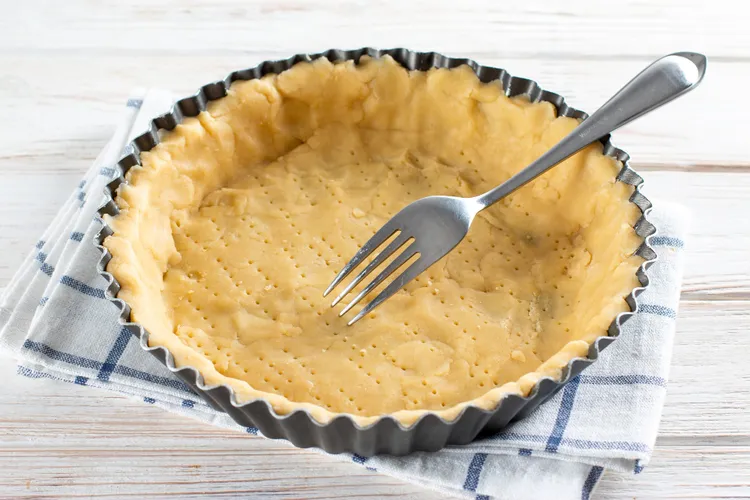
Step 5 - Line the tin: Gently ease the pastry into the tin without stretching. Press into the corners with your fingers. Stretching the pastry to reach the corners builds tension that will cause the pastry to spring back (shrink) during baking.
Let the overhang hang over the edge - don't trim yet. Refrigerate the lined tin for 30 minutes before blind baking (the second refrigeration further relaxes the gluten and firms the butter).
Step 6 - Blind bake: Preheat the oven to 190°C (fan). Scrunch a sheet of parchment paper, unscrunch it (this makes it more flexible and less likely to damage the pastry), and press it into the lined tin, covering the base and sides completely. Fill with baking weights, dried beans, or uncooked rice.
Why blind bake? The pastry base needs to be pre-baked before a wet filling is added - otherwise the filling saturates the uncooked pastry before it can set, producing a soggy bottom. The weights prevent the pastry from puffing up during baking (the steam produced from the butter and water in the pastry would otherwise create bubbles under the base).
Bake for 15 minutes with the weights in. Remove the parchment and weights. Bake for a further 5-8 minutes until the base is pale golden and dry - no raw, shiny patches. Remove from the oven. The pastry is now ready for a filling.
Trimming the overhang: After the first 15 minutes with weights, while the pastry is still warm and pliable, trim the overhang with a sharp knife flush to the tin rim. Do this at this stage (not before baking) because pastry shrinks during baking - trimming before baking produces pastry that drops below the rim as it shrinks.
Sweet Shortcrust (Pâte Sucrée)
Makes enough for 1 × 23cm sweet tart case
Ingredients
- 200g plain flour
- 100g unsalted butter, cold, cubed
- 80g icing sugar, sifted - icing sugar rather than caster for a smoother, more refined result
- 1 large egg yolk
- 2-3 tbsp ice-cold water
- ½ tsp vanilla extract (optional)
- Pinch of fine salt
Method Differences from Savoury
Sift the icing sugar into the flour and salt before rubbing in the butter - sugar must be evenly distributed before the fat is added.
Add the egg yolk with the water - whisk them together with the vanilla before drizzling over the crumb mixture. The yolk provides additional fat and protein, producing a pastry that is slightly richer, slightly crispier, and more cohesive when baked.
The dough will be slightly stickier than savoury shortcrust due to the egg. Handle minimally, rest generously (1 hour is better than 30 minutes for sweet shortcrust).
Bake at 180°C (slightly lower than savoury shortcrust - the sugar browns faster and the lower temperature prevents over-browning before the pastry is fully set).
Use for: Lemon tart, fruit tarts, custard tart, mince pies, chocolate tart. See Lemon Tart: The Patisserie Standard at Home for the complete application.
Why Pastry Shrinks (and How to Prevent It)
Shrinkage is the most common shortcrust complaint - the pastry that lined the tin perfectly before baking ends up several centimetres short of the rim after 15 minutes in the oven.
The cause: Gluten developed during mixing. Gluten is elastic - it wants to contract to its natural, shorter length. When the pastry is rolled out and stretched into the tin, the gluten is under tension. In the oven's heat, the gluten contracts - pulling the pastry inward and down.
The prevention:
- Minimal handling - every touch develops gluten
- Refrigerator resting - before and after lining the tin. Two rests of 30 minutes each
- Don't stretch the pastry when lining - ease it in; let gravity help
- Leave the overhang until after blind baking - it shrinks inward rather than below the rim
- Use cold ingredients - cold temperatures slow gluten development and keep the butter in discrete pieces
Following these five steps eliminates shrinkage almost completely. The rare cases that still shrink despite correct technique usually involve over-processed pastry (butter smeared rather than rubbed) or insufficient resting time.
Pro Tips
- Cold everything. Cold butter, cold water, cold bowl, cold hands. Every degree of warmth makes the butter softer and the gluten more active. On a warm day, put the bowl and the flour in the refrigerator for 20 minutes before starting.
- Overworked pastry cannot be fixed. Once gluten is developed, it cannot be un-developed. A dough that has been overworked will produce tough pastry that shrinks - there is no recovery. Make a new batch. Prevention is the only solution.
- The food processor is faster but riskier. A food processor can make excellent shortcrust pastry quickly, but it is also very easy to overprocess - one extra pulse can take the mixture from perfect crumbs to a cohesive ball (overworked). Pulse no more than 10-12 times; transfer to a bowl before adding water.
- Blind baking weights matter. Rice, dried beans, or ceramic baking weights - all work. The weight must cover the base and reach up the sides of the pastry, or the sides will collapse inward.
Common Mistake: Adding Too Much Water Over-watered pastry develops more gluten, producing an elastic dough that is easier to work with but tougher and more prone to shrinkage when baked. The dough should feel barely together - almost crumbly - when pressed. If you can roll it out without it cracking, it has enough water. Add less than you think you need; press to test. A slightly dry pastry that crumbles at the edges when rolled can be pressed back together. An over-watered pastry cannot be corrected.
FAQ
Q: Can I use the same shortcrust for sweet and savoury applications?
The savoury version (no sugar) works in sweet applications in a pinch, but the absence of sugar produces a less complex, slightly more bread-like base. The sweet shortcrust (pâte sucrée) with icing sugar and egg yolk produces a noticeably more refined, crispier, more patisserie-style result for sweet tarts.
Q: Can I make shortcrust pastry ahead and freeze it?
Yes - wrap the disc of dough tightly in cling film and freeze for up to 3 months. Thaw overnight in the refrigerator. Alternatively, line the tin with the pastry and freeze the lined unbaked shell - bake directly from frozen, adding 5 minutes to the blind baking time.
Q: My pastry is cracking as I roll it. What went wrong?
The dough is too cold (straight from the refrigerator) or too dry. Let it sit at room temperature for 5 minutes before rolling. If it cracks, press the crack together firmly with your fingers - the fat content of the pastry seals it effectively - and continue rolling.
🔗 Use Your Pastry
Latest