No-Bake Cheesecake: The Version That Actually Sets
Why so many no-bake cheesecakes don't set - and the specific ratios that produce the firm, sliceable result every time
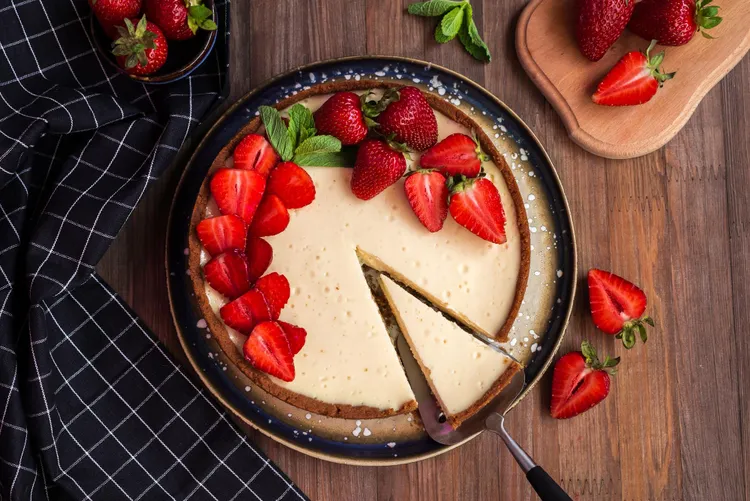
No-bake cheesecake is the most searched no-bake dessert for a reason: the premise is irresistible. No oven, no water bath, no cracking to worry about - just a biscuit base, a cream cheese filling, and refrigeration. The problem: most no-bake cheesecakes don't set. The filling remains soft and spreadable rather than firm and sliceable. Unmoulding produces a collapse or a mess.
The failure has specific causes, and understanding them makes the difference between a dessert that needs to be scooped from the tin and one that unmoulds cleanly and holds its shape at the table.
Why No-Bake Cheesecakes Don't Set: The Three Causes
Cause 1 - Low-fat cream cheese. Full-fat cream cheese contains 30-33% fat. This fat is what provides the structure when whipped and chilled. Low-fat cream cheese contains 15-20% fat - it has too much water content and too little fat to set firmly without gelatin. The instruction "full-fat cream cheese" is not a preference; it is a structural requirement.
Cause 2 - Under-whipped double cream. The double cream must be whipped to stiff peaks (not soft peaks) before being folded into the cream cheese mixture. Stiff peaks mean the cream stands upright when the whisk is lifted. Under-whipped cream is still liquid enough to keep the mixture pourable rather than thick, and it collapses during refrigeration. Soft peak cream produces a soft, spreadable cheesecake. Stiff peak cream produces a sliceable one.
Cause 3 - Too much liquid flavouring. Lemon juice, fruit purée, or other liquid additions dilute the cream cheese mixture and reduce its ability to set. The amounts in this recipe are calibrated to add flavour without compromising structure.
Ingredients
Serves 10-12 | Active time: 20 minutes | Refrigeration: minimum 6 hours, ideally overnight
The Base
- 300g digestive biscuits (or Hobnobs for a more oaty base, or Oreos for a chocolate base with the filling scraped out)
- 120g unsalted butter, melted
- Pinch of fine sea salt
The Filling
- 600g full-fat cream cheese (Philadelphia or equivalent), at room temperature - full-fat is non-negotiable
- 300ml double cream, cold from the refrigerator
- 100g icing sugar, sifted
- 2 tsp vanilla extract
- Finely grated zest of 1 lemon - zest adds flavour without adding liquid
- 2 tsp lemon juice - no more; additional lemon juice risks a too-soft set
Method
Step 1: Make the base
Blitz the biscuits in a food processor until fine crumbs. If no food processor: place in a sealed bag and crush with a rolling pin - the result is slightly less uniform but works well.
Combine the crumbs with the melted butter and a pinch of salt. Mix until the crumbs are evenly coated and the mixture holds together when pressed. It should feel like damp sand.
The press test: Pinch a small amount - it should hold together without being greasy. If it crumbles without cohering: add 1 more tbsp of melted butter. If it looks oily: the butter-to-biscuit ratio was off from the start; add more crushed biscuits.
Press evenly into a 23cm springform tin, covering the base and going 1cm up the sides. Use the back of a spoon or the base of a flat-bottomed glass to press firmly and evenly. The base must be compacted firmly - a loose base crumbles when the cheesecake is sliced.
Refrigerate for at least 30 minutes while preparing the filling - the butter needs to set before the filling goes on.
Step 2: Make the filling
The cream cheese must be at room temperature. Cold cream cheese clumps when beaten and never fully smooths out. Leave at room temperature for at least 1 hour before starting.
Step 2a - Beat the cream cheese: Beat the room-temperature cream cheese with an electric hand mixer or stand mixer on medium speed until completely smooth and lump-free (2-3 minutes). Scrape down the sides of the bowl.
Add the sifted icing sugar, vanilla extract, lemon zest, and lemon juice. Beat until combined and smooth.
Step 2b - Whip the double cream: In a separate bowl, whip the cold double cream with the clean beaters to stiff peaks - when the beaters are lifted, the cream forms peaks that stand upright without folding over. This is beyond the "soft peak" stage where they curl slightly. Time: approximately 3-4 minutes with a hand mixer, starting on medium speed and increasing to high.
The cold cream requirement: Cold cream whips more efficiently and produces a more stable foam. Cream at room temperature takes significantly longer to whip and may never reach the stiff peak stage.
Step 2c - Fold together: Add the whipped cream to the cream cheese mixture. Fold with a large spatula - slow strokes from the bottom of the bowl, cutting through the cream, turning and folding. The goal is to combine the two without deflating the air in the whipped cream.
Fold until just combined with no streaks of cream remaining. Do not over-mix.
Step 3: Fill and refrigerate
Spoon the filling onto the chilled biscuit base. Smooth the top with a palette knife or the back of a spoon. For a very smooth top: hold a palette knife at 45° and rotate the tin under it.
Cover with cling film (not touching the surface - tent loosely) and refrigerate for a minimum of 6 hours. Overnight is better. The filling sets gradually as the fat in the cream cheese crystallises in the cold.
The set test: After the minimum refrigeration time, gently shake the tin. A properly set cheesecake should wobble slightly in the centre as a unified mass - not slosh as a liquid. The edges should be completely firm.
Step 4: Unmould
Run a thin knife or palette knife around the edge between the cheesecake and the tin (even with a springform, the cream cheese can stick). Release the springform clasp slowly. If using a solid tin: see the tin-lining approach below.
For the cleanest unmoulding: Place the tin on a tin of beans or similar to raise it. Undo the springform clasp. Lower the sides away from the cheesecake rather than lifting the cheesecake from the tin.
Transfer to a serving plate. If the base is too firm to slide off the springform base: run a palette knife under it and carefully slide onto the serving plate.
Five Topping Variations
All toppings are added immediately before serving - never before refrigeration.
Classic Strawberry
Hull and halve 400g of strawberries. Arrange in a single layer, cut side up, over the surface. Brush with a little warmed strawberry jam for gloss. The simplest and most classic topping.
Mango and Passion Fruit
Peel and slice 2 ripe mangoes. Arrange over the cheesecake. Scoop the pulp and seeds of 4 passion fruits over the mango. The sweet-tart tropical combination is one of the most vibrant toppings in this collection.
Salted Caramel
Make a dry caramel: heat 150g caster sugar in a dry pan until amber. Add 120ml double cream (carefully - it will spit). Add 50g butter and 1 tsp sea salt. Stir until smooth. Cool to a thick but pourable consistency. Pour over the cheesecake, allowing it to drip naturally over the edges.
Blueberry Compote
Combine 300g blueberries + 3 tbsp sugar + juice of ½ lemon in a small pan. Simmer 8 minutes until the blueberries burst and the mixture thickens to a syrup. Cool completely before spooning over the cheesecake.
Oreo Cookie
Crush 10 Oreo cookies roughly - some fine, some larger pieces. Scatter over the top. Drizzle with the chocolate fudge sauce from the Hot Chocolate Fudge Sauce post. The cookie-and-cream combination on a cream cheese base is consistently the most popular version.
The Tin-Lining Approach (No Springform Required)
Line a regular 23cm cake tin with enough cling film to overhang the sides by 10cm on all sides. Press the base in, add the filling, refrigerate. To unmould: lift the cling film overhang and pull the cheesecake up and out of the tin onto the serving plate. Peel away the cling film.
Less elegant than a springform but entirely functional.
Pro Tips
- Full-fat cream cheese. The single most important instruction. Philadelphia Original (full-fat, the block) is the reference product. Reduced-fat, light, or spreadable versions do not set correctly.
- Stiff peaks on the cream. The cream that seems adequately whipped at 2 minutes is probably at the soft peak stage. Continue for another 1-2 minutes. When the bowl can be held inverted and the cream doesn't move: it is at stiff peaks.
- Overnight refrigeration. The minimum 6-hour set produces a cheesecake that will hold together for slicing but may have a slightly mousse-like texture in the centre. Overnight produces a firmer, more stable result.
- Room-temperature cream cheese. As important as the full-fat instruction. Cold cream cheese that is beaten into the mixture before it softens produces a lumpy filling that doesn't smooth out regardless of how long it is beaten.
The Most Common No-Bake Cheesecake Failure: Reduced-Fat Cream Cheese Reduced-fat cream cheese contains too much water and too little fat to set without gelatin. Even with perfectly whipped double cream and overnight refrigeration, a reduced-fat cream cheese filling remains soft and collapses when sliced. Always use full-fat. The difference in calorie content between a slice of full-fat and reduced-fat no-bake cheesecake is not significant relative to the portion size of a dessert. The difference in whether it sets is definitive.
FAQ
Q: Can I add gelatin to ensure it sets?
Gelatin produces a more reliably firm set but also a slightly different texture - more like a refrigerated mousse than the soft-but-sliceable texture that this recipe produces with full-fat cream cheese. If you specifically want a very firm set (for transport, or for a hot environment): bloom 2 tsp powdered gelatin in 2 tbsp cold water, warm gently until dissolved, cool to room temperature, then fold into the cream cheese mixture before adding the whipped cream.
Q: Can I use whipping cream instead of double cream?
Whipping cream (approximately 35% fat) can work but is less stable than double cream (approximately 48% fat). Use the same technique (cold cream, stiff peaks) and increase to 350ml to compensate for the lower fat content.
Q: How far ahead can I make this?
The cheesecake can be made up to 48 hours ahead and kept covered in the refrigerator. Add the topping just before serving. Beyond 48 hours, the base can become slightly soft from the moisture in the filling.
🔗 More Desserts
Latest