Lemon Tart: The Patisserie Standard at Home
Pâte sucrée, bain-marie lemon curd, and the exact temperature that produces a filling that quivers and melts - the French tarte au citron done properly
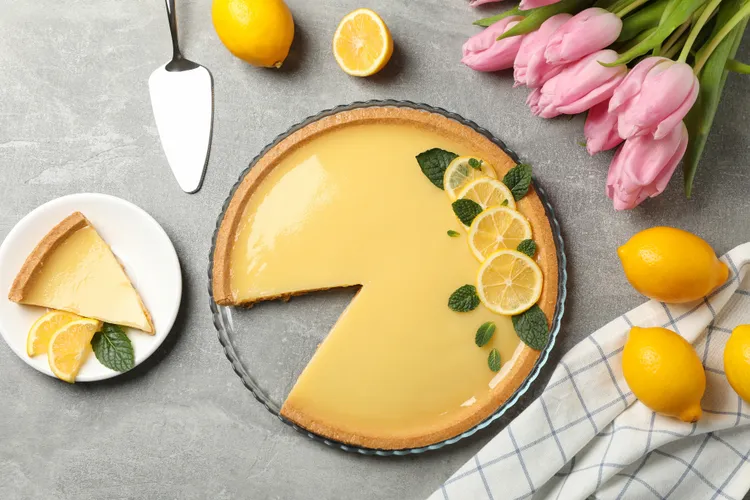
The lemon tart - tarte au citron in French - is the most technically demanding dessert in this collection. The pâte sucrée (sweet shortcrust pastry) must be made correctly to produce a shell that is simultaneously crisp and short, not soft or crumbly. The lemon curd filling must be cooked to exactly the right temperature - enough to set when cool, not so much that it scrambles or becomes grainy. And the flavour must be intensely, almost aggressively lemony - the tarte au citron is not a lemon-flavoured custard tart. It is a lemon tart.
Done correctly, the lemon tart is one of the great things in the French patisserie repertoire - a tart with a crisp, buttery shell, a filling that barely holds its shape, and a flavour that is simultaneously sweet and bracingly acidic in perfect balance. It is worth the effort.
The Components
Pâte sucrée (sweet shortcrust pastry): Different from standard shortcrust in its higher butter and sugar content, which produces a more delicate, crisp, slightly sweet shell - the correct vehicle for the sharp filling.
Lemon curd filling: Eggs, butter, sugar, and lemon juice, cooked slowly over a bain-marie until the proteins in the eggs set into a thick, smooth, pourable custard. The bain-marie is the technique that prevents the eggs from scrambling - and the temperature (82°C) is the target that determines when the filling is done.
Part 1: Pâte Sucrée
Makes enough for 1 × 23cm tart shell
Ingredients
- 200g plain flour, plus extra for dusting
- 100g cold unsalted butter, cut into small cubes
- 60g icing sugar, sifted
- 1 large egg yolk
- 2-3 tbsp cold water
- Pinch of fine salt
Method
Rub the butter into the flour: Place the flour, icing sugar, and salt in a large bowl. Add the cold butter cubes. Rub the butter into the flour with your fingertips - lifting the mixture and pressing the butter between thumb and fingers - until the mixture resembles fine breadcrumbs with no large butter pieces remaining.
Add the yolk: Make a well in the centre. Add the egg yolk. Mix with a fork, then add cold water one tablespoon at a time, mixing after each addition, until the pastry just comes together. It should not be wet or sticky - add only enough water for the dough to cohere.
Shape and chill: Turn onto a lightly floured surface. Bring together gently with your hands into a disc - do not knead or over-work. Wrap in cling film. Refrigerate for 30 minutes minimum (up to 24 hours).
Roll and line: On a lightly floured surface, roll the pastry to approximately 3mm thickness. Line a 23cm loose-bottomed tart tin, pressing the pastry into the edges. Trim the excess. Refrigerate for a further 20 minutes - this relaxes the gluten and prevents shrinkage during blind baking.
Blind bake: Preheat the oven to 180°C (fan). Line the pastry case with parchment, fill with baking beans or rice. Bake for 15 minutes. Remove the beans and parchment. Return to the oven for a further 8-10 minutes until the base is pale golden and completely dry. The base must be fully baked before the filling is added - any moisture in the pastry will produce a soggy bottom.
Allow to cool completely before filling.
Part 2: Lemon Curd Filling
Ingredients
- 4 large eggs + 4 large egg yolks - the extra yolks produce a richer, smoother, more intensely coloured curd
- 200g caster sugar
- Finely grated zest of 3 unwaxed lemons - the zest is the aromatic element; use organic or unwaxed lemons
- 180ml fresh lemon juice (approximately 4-5 lemons) - always fresh, never bottled; the flavour is not equivalent
- 150g cold unsalted butter, cut into small cubes
Method
Step 1 - Combine: In a large heatproof bowl, whisk together the whole eggs, egg yolks, caster sugar, lemon zest, and lemon juice until combined.
Step 2 - Cook over a bain-marie: Set the bowl over a saucepan of barely simmering water - the bowl must not touch the water. Stir continuously with a heatproof spatula, scraping the base and sides of the bowl.
The curd will initially be very liquid and frothy. As it heats, it will slowly thicken. After approximately 12-15 minutes of continuous stirring, it will reach the correct set - thick enough to coat the spatula, with a clear line drawn through the coating by a finger.
The temperature target: 82°C. At this temperature, the egg proteins are set enough to produce a stable curd when cooled, but not scrambled. Use an instant-read thermometer - the target is specific.
Remove from heat at 82°C.
Step 3 - Add the butter: Add the cold butter cubes in three additions, stirring vigorously between each. The cold butter cools the curd slightly and enriches it - the emulsified butter is part of the curd's silkiness.
Step 4 - Strain: Pour the curd through a fine-mesh sieve into a jug. This removes the lemon zest (which has given its flavour to the curd), any bits of cooked egg, and produces an exceptionally smooth, glossy filling.
Assembly and Baking the Filled Tart
Preheat the oven to 150°C (fan).
Pour the warm lemon curd into the cooled blind-baked pastry shell - fill to just below the rim. The curd should be warm (not cold and set) when poured - it levels itself more smoothly at a pourable consistency.
Bake for 12-15 minutes at 150°C until the filling is just set - it should wobble as a single cohesive mass when the tin is gently shaken, with no sloshing liquid visible. The filling should not be browned.
The just-set principle: The lemon curd was already cooked to 82°C on the stovetop. The oven bake is a gentle, brief set - just enough to ensure the filling holds its shape when sliced. Over-baking produces a filling that is too firm and loses the delicate quiver that defines a perfect lemon tart.
Remove from the oven. Allow to cool completely at room temperature - approximately 2 hours. The filling sets further as it cools.
Finishing Options
Plain (the classic French approach): The lemon tart needs no decoration. A perfectly smooth, intensely yellow surface is its own presentation.
Dusted with icing sugar: Sift a light, even layer of icing sugar over the surface immediately before serving. The white against the yellow is visually striking.
Brûléed: Sprinkle a thin layer of caster sugar over the cooled surface. Brûlée with a kitchen blowtorch to produce a caramel top - the crunchy caramel against the tart lemon filling is an excellent variation.
Raspberry garnish: Arrange 150g of fresh raspberries over the surface. Their acidity complements the lemon; their colour is beautiful.
Whipped cream or crème fraîche: Served alongside rather than on the tart - the richness and slightly sour cream note against the sharp lemon is the classic accompaniment.
Make-Ahead
Pastry shell: Can be blind-baked up to 2 days ahead and kept in the tin, loosely covered, at room temperature.
Lemon curd: Can be made up to 4 days ahead and refrigerated. Reheat gently until pourable before filling the tart.
Assembled tart: Best eaten within 24 hours of assembly - the pastry begins to soften from the filling's moisture beyond this. Refrigerate the assembled tart and remove 30 minutes before serving (the filling is best at cool room temperature, not cold).
Pro Tips
- Fresh lemon juice only. The difference between a tart made with fresh lemon juice and one made with bottled is immediately apparent - fresh juice has volatile aromatic compounds that bottled juice loses. Use fresh.
- Don't stop stirring the curd. Any moment of stillness on the bain-marie allows the egg proteins at the base to cook ahead of the rest, producing lumps. Continuous stirring is the entire technique.
- Strain always. The sieve catches any cooked egg bits (from momentary overheating) and the zest (which has done its job). A strained curd is silky; an unstrained one is not.
- The 82°C thermometer reading is more reliable than visual cues. The curd looks done before it is done, and looks not done before it's at the right temperature. Use the thermometer.
🔗 More Pastry and Tart Desserts
Latest