Why You Should Salt Meat in Advance
Most home cooks salt meat right before it hits the pan - and most professional cooks consider that a missed opportunity. Salting meat hours or even days in advance isn't just about flavour: it fundamentally changes the protein structure, moisture retention, and surface texture of the meat in ways that last-minute seasoning physically cannot achieve. Here's the science behind it, and the exact timing that produces the best results.
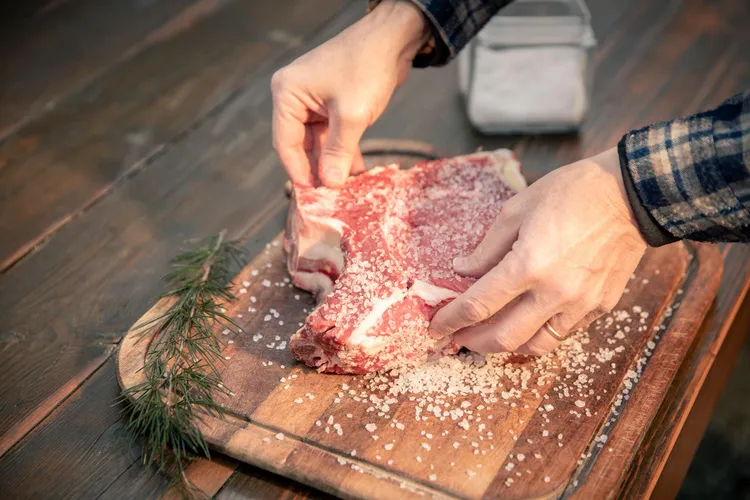
Here's a question that reveals a gap in most home cooks' knowledge: what is the difference between a steak salted one minute before cooking and the same steak salted 24 hours before cooking? The answer isn't just "more evenly seasoned." At 24 hours, the steak is a fundamentally different piece of meat - with altered protein structure, improved moisture retention, better surface conditions for browning, and seasoning distributed through the flesh rather than sitting on top of it.
The technique is called dry brining. It costs nothing, requires no special equipment, and produces results that a well-seasoned last-minute salt simply cannot replicate. The reason is osmosis, protein chemistry, and time.
Answer
Salting meat in advance - ideally 1-24 hours for steaks and chops, up to 72 hours for larger cuts - draws moisture to the surface through osmosis, dissolves some of the surface proteins, and then allows that protein-rich brine to be reabsorbed back into the meat. The result is meat that is seasoned throughout (not just on the surface), retains more moisture during cooking, and develops a drier surface that produces a dramatically better crust. The longer the salt has, the deeper and more complete these effects become.
The Three Stages of Dry Brining
Stage 1 - The Draw (0-40 minutes): Moisture Rises to the Surface
Within minutes of applying salt to meat, osmosis begins. Salt on the surface creates a high-concentration environment that draws moisture from inside the meat outward through the cell walls. Within 20-40 minutes, you can visibly see small beads of moisture forming on the surface of the meat. The meat looks wet; the surface is covered in a dilute brine.
This is the worst possible moment to cook the meat. The surface moisture will cause steaming rather than searing in the pan, producing a grey, poorly crusted exterior. If you're going to salt immediately before cooking, it's better to do it one to two minutes before - close enough that osmosis hasn't had time to pull meaningful moisture to the surface yet.
Stage 2 - Dissolution (40 minutes to 1 hour): Proteins Begin to Break Down
As the salt-drawn moisture pools on the surface, the salt dissolves into it - creating a concentrated brine. This brine begins to denature and dissolve some of the proteins on the meat's surface, particularly myosin. The surface of the meat becomes slightly tacky and sticky - a sign that protein dissolution is underway.
This protein dissolution is critical to what comes next. The proteins that dissolve into the surface brine are the proteins that will later be reabsorbed back into the meat - carrying the salt's seasoning with them.
Stage 3 - Reabsorption (1 hour onwards): The Brine Goes Back In
This is where the real transformation happens. By around the one-hour mark, the osmotic gradient has reversed. The surface brine - now carrying both moisture and dissolved proteins - begins to be reabsorbed back into the meat through the same cellular pathways it left through. The salt, and the dissolved proteins, travel inward along with it.
At 1 hour: the brine has been partially reabsorbed. The surface is drier than at Stage 1, and the seasoning has penetrated slightly into the flesh.
At 4-6 hours: significantly more reabsorption has occurred. The seasoning has moved noticeably deeper into the meat. The surface is considerably drier.
At 24 hours: the surface is dry enough to produce an excellent crust without any additional patting down. The seasoning has penetrated deep into the flesh. The protein dissolution and reabsorption cycle has had time to meaningfully tenderise the outer layers of the meat.
At 48-72 hours (larger cuts, roasts): seasoning has reached the deep interior. Surface dryness is excellent. The enzymatic tenderisation that runs alongside this process has had significant time to work on collagen and connective tissue.
"Salting right before cooking seasons the crust. Salting in advance seasons the meat."
What Most People Get Wrong
| Myth | Fact |
|---|---|
| Salting in advance dries the meat out. | The opposite is true for anything beyond a 40-minute window. Once Stage 3 reabsorption is complete, the meat retains more moisture during cooking than unsalted meat - because the salt has altered the protein structure in ways that reduce moisture expulsion under heat. |
| You can achieve the same effect by brining in saltwater (wet brining). | Wet brining and dry brining produce different results. Wet brining adds moisture (useful for lean, dry cuts like chicken breast or pork loin) but can dilute flavour. Dry brining concentrates flavour, improves surface texture, and seasons more deeply without adding excess water. Most chefs prefer dry brining for most applications. |
| More salt means better results. | Salt draws moisture proportional to concentration - too much salt on the surface can over-draw moisture and can over-season. A general guideline: approximately ¾ teaspoon of kosher salt per pound of meat (about 0.5% of the meat's weight) is enough for most applications. |
| Salting in advance only matters for large cuts like roasts. | Even a steak benefits significantly from 1-4 hours of advance salting. The difference in crust quality, moisture retention, and even flavour distribution is noticeable at just one hour. |
| Regular table salt works the same as kosher salt for dry brining. | Table salt is significantly finer and denser than kosher salt - a teaspoon of table salt contains roughly twice the sodium of a teaspoon of kosher salt by volume. Using table salt in the same quantity as kosher salt will over-season. If using table salt, halve the quantity. |
The Timing Guide: How Long to Salt Before Cooking
| Cut | Minimum Time | Optimal Time | Maximum Benefit |
|---|---|---|---|
| Thin steak (under 2cm) | 45 min | 1-2 hours | 4 hours |
| Thick steak (2-4cm) | 45 min | 4-6 hours | 24 hours |
| Chicken pieces (bone-in) | 1 hour | 12-24 hours | 48 hours |
| Whole chicken | 4 hours | 24 hours | 48-72 hours |
| Pork chops | 45 min | 4-6 hours | 24 hours |
| Pork shoulder / roast | 4 hours | 24 hours | 48-72 hours |
| Lamb chops | 45 min | 4-6 hours | 24 hours |
| Leg of lamb | 4 hours | 24 hours | 48-72 hours |
| Fish fillets | 15 min max | - | Never advance salt fish for more than 30 minutes - it begins to cure |
| The dead zone | 40 min - 1 hour | - | Worst possible timing - surface wet, brine not yet reabsorbed |
What Most People Get Wrong About Surface Dryness
This is the detail that elevates dry-brined meat from "slightly better" to "dramatically better": the surface dryness produced by advance salting is exactly what enables the Maillard reaction to work at its most efficient.
The Maillard reaction - the browning chemistry responsible for the golden crust on a sear - requires surface temperatures above 140°C / 285°F. Water boils at 100°C. Any water on the surface of the meat must evaporate before the surface can reach Maillard temperatures. A wet-surfaced steak spends the first minute of searing time evaporating surface moisture; the meat steams during this period and develops no crust.
A dry-brined steak enters the pan with almost no surface moisture. The surface reaches Maillard temperatures within seconds. The crust develops immediately and completely. The difference in crust quality between a properly dry-brined steak and one salted at the last minute is visible and significant - even to a first-time observer.
How to Dry Brine at Home
The basic method
Pat the meat completely dry with kitchen paper. Apply salt evenly on all sides - including the edges - using approximately ¾ teaspoon of kosher salt per pound (450g) of meat, or about 0.5% of the meat's weight. Place on a wire rack over a tray (never flat on a plate - the underside needs airflow) and refrigerate uncovered. The refrigerator's dry environment accelerates surface drying.
Remove from the fridge 30-45 minutes before cooking to allow the surface to come closer to room temperature and to let any residual surface moisture continue evaporating.
Do not cover the meat in the fridge
Covering the meat with cling film traps moisture against the surface - the opposite of what you want. The whole point of refrigerating uncovered is to use the dry fridge air to further desiccate the surface, creating ideal conditions for a fast, complete crust in the pan.
Add aromatics if you want - but timing matters
Garlic, fresh herbs, and spices can be applied alongside salt for dry brining. However, fresh garlic and wet aromatics applied directly to the surface can reintroduce moisture during the brining period. The solution: apply salt first, allow the surface to dry for the brining period, then add aromatics in the final 30 minutes before cooking or directly to the pan during cooking.
For chicken: focus on the skin
Chicken skin is particularly responsive to dry brining because the high moisture content of raw skin is what makes it difficult to crisp. Salt draws moisture from the skin, the skin dries in the fridge, and the result is a dramatically crisper skin after roasting than any fresh-from-the-fridge, last-minute-salted bird could achieve. Dry-brined chicken skin crackles. Wet-surfaced chicken skin steams.
The Dry Brine vs Wet Brine Comparison
| Dry Brine | Wet Brine | |
|---|---|---|
| What it does | Draws moisture out, dissolves proteins, reabsorbs brine | Adds moisture through osmosis into already-wet brine |
| Best for | Steaks, chops, whole birds, roasts - most meat | Lean cuts prone to dryness: chicken breast, pork loin, turkey |
| Effect on flavour | Concentrates and deepens flavour | Can dilute flavour slightly |
| Effect on surface | Dries the surface - excellent for crust | Adds moisture - can make crust development harder |
| Effect on weight | Meat loses moisture during brine, then regains it | Meat gains weight from absorbed water |
| Time required | 1-72 hours depending on cut | 4-48 hours depending on cut |
| Equipment | Salt, wire rack, refrigerator | Salt, water, large container, refrigerator |
| Result | Deep flavour, excellent crust, good moisture retention | Added juiciness in lean cuts, milder flavour impact |
Why Restaurant Kitchens Salt Everything in Advance
In a professional kitchen, the concept of last-minute salting applies only to a narrow set of preparations - quick-cooked fish, delicate vegetables, and situations where salt would draw moisture at a problematic rate. For virtually everything else - meat, poultry, roasts - advance salting is considered the baseline practice, not an optional upgrade.
Restaurant butchers and prep cooks salt meat as one of the first tasks of the day, sometimes even during the previous day's close. By service time, that meat has been dry-brining for 12-24 hours. The cooks don't add salt at the pan - the salt is already inside the meat.
One specific professional habit worth adopting: the Sunday salt. Many chefs who care about home cooking apply salt to the week's primary proteins on Sunday evening - a steak for Tuesday, a chicken for Wednesday, a pork shoulder for the weekend. Each piece goes on a rack, uncovered, in the fridge. By the time each one is cooked, it's been transformed by the brining process into something that last-minute seasoning simply cannot match.
The investment: two minutes on Sunday. The return: measurably better meat every day of the week.
Bonus Fact
The word "salary" comes from the Latin salarium - a payment made to Roman soldiers, partly in salt or for the purchase of salt. Salt was so valuable in the ancient world that it was used as currency, formed the basis of trade routes, and was actively taxed by governments for centuries. The French gabelle - the salt tax - was one of the most resented taxes in pre-revolutionary France and is considered one of the contributing causes of the French Revolution. A crystalline mineral that most people now measure by the pinch was once literally worth fighting wars over. The fact that you can use it to transform a piece of meat overnight for essentially no cost is one of the great bargains in food history.
Here's What It All Comes Down To
Salting meat in advance is not a variation on last-minute seasoning - it is a fundamentally different process that produces fundamentally different results. The three-stage osmosis and protein reabsorption cycle seasons the meat from the inside out, creates optimal surface conditions for crust development, and improves moisture retention during cooking. None of these effects are achievable by salting right before the pan.
The timing matters: avoid the 40-minute-1-hour dead zone where the surface is wet but the brine hasn't reabsorbed. Salt either immediately before (within two minutes) or advance-salt for at least one hour - ideally much longer.
The method is simple. The equipment is a rack and a fridge. The cost is nothing. The improvement is consistent and measurable.
Salt it early. Every time.
In Short
- Advance salting works through a three-stage process: osmosis draws moisture to the surface (Stage 1), salt dissolves into the moisture and begins breaking down surface proteins (Stage 2), and the protein-rich brine is reabsorbed back into the meat (Stage 3).
- The "dead zone" - 40 minutes to 1 hour after salting - is the worst time to cook. Surface moisture has been drawn out but hasn't yet been reabsorbed, causing steaming rather than searing.
- Advance salting dries the surface, which enables faster and more complete Maillard browning - the chemistry behind a proper crust.
- Properly dry-brined meat retains more moisture during cooking than unsalted meat, because the altered protein structure resists moisture expulsion under heat.
- Use approximately ¾ teaspoon of kosher salt per pound (450g) of meat, or roughly 0.5% of the meat's weight. Table salt requires half the volume of kosher salt.
- Always rest dry-brining meat on a wire rack, uncovered, in the fridge - the dry air accelerates surface desiccation.
- For chicken: dry brining is the most effective method for achieving genuinely crisp skin - it removes the surface moisture that otherwise causes steaming.
- Dry brining concentrates and deepens flavour; wet brining adds moisture. Dry brine is preferred for most meat; wet brine is most useful for lean cuts prone to dryness.
- The word "salary" derives from salarium - Roman soldier payment in salt - reflecting how precious salt once was as a commodity.
Latest