Tarte Tatin: The Upside-Down Apple Tart
The French classic that began as an accident - caramelised apples under a golden pastry lid, inverted at the table
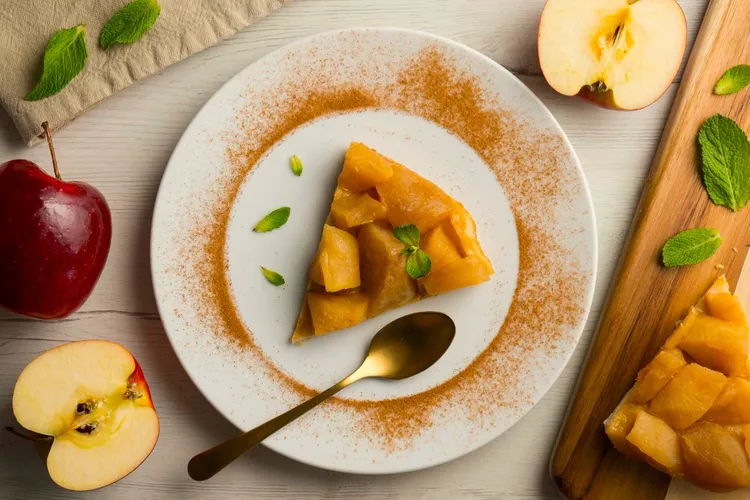
Tarte Tatin was created accidentally - the Tatin sisters, running a hotel in Lamotte-Beuvron in the Loire valley in the early 1900s, placed an apple tart in the oven the wrong way up, pastry on top, fruit and caramel on the bottom, and discovered that the result was better than anything they had intended. Whether the story is entirely true is debated by food historians. What is not debated: the result - buttery apples in a deep, dark caramel beneath a golden pastry lid, inverted to reveal the gleaming, layered apples - is one of the great desserts of the French repertoire.
It requires attention at two stages: the caramel (dark enough to be complex, not so dark it is bitter) and the apple cooking (firm enough that the apples hold their shape after baking, not so soft they collapse). Beyond these two moments, the tarte Tatin is more forgiving than it appears.
The Apples: Why Variety Matters
The apple must be firm-fleshed and low in moisture. A high-moisture apple (Bramley) collapses to mush during the double cooking (stovetop caramelisation + oven baking). A perfectly firm-fleshed apple (Cox, Braeburn, Golden Delicious, Pink Lady, Granny Smith) holds its shape through both stages and produces the layered, distinct apple slices that characterise a proper tarte Tatin.
Best varieties: Cox, Braeburn, Golden Delicious, Pink Lady, Granny Smith. All produce firm, flavourful results. Avoid: Bramley (too soft and wet), Gala (lacks structure), McIntosh (collapses easily).
The Pastry
Rough puff pastry produces a noticeably better tarte Tatin than shop-bought shortcrust - the laminated layers puff during baking and produce a lighter, more dramatic lid. Shop-bought all-butter puff pastry is an entirely acceptable substitute and produces excellent results with less effort.
For rough puff pastry: see Rough Puff Pastry in the Baking collection.
Ingredients
Serves 8 | Active time: 30 minutes | Baking: 25-30 minutes | Serves from a 24cm ovenproof frying pan
- 8-10 medium apples (approximately 1.4-1.6kg), Cox or Braeburn - firm-fleshed varieties
- 150g caster sugar
- 80g unsalted butter, cut into small cubes
- 1 tsp vanilla extract
- Pinch of fine salt
- 1 sheet of all-butter puff pastry (320g ready-rolled) or rough puff pastry rolled to 3mm
Method
Step 1: Prepare the apples
Peel, quarter, and core the apples. If using a large variety, cut each quarter in half lengthways. The pieces should be approximately 3-4cm - large enough to hold their shape during cooking.
Step 2: Make the caramel in the pan
Use a 24cm ovenproof frying pan - cast iron is ideal for its heat retention and ovenproof properties, but any heavy ovenproof frying pan works.
Dry caramel method: Scatter the 150g of caster sugar evenly across the base of the pan. Heat over medium heat - do not stir. Watch as the sugar at the edges begins to melt and colour. When approximately half the sugar has melted, begin moving the pan gently to promote even melting. Continue until all the sugar is melted and the caramel is deep amber - the colour of dark honey.
Remove from heat. Add the butter cubes carefully (the caramel will bubble vigorously). Stir gently until the butter is completely melted and incorporated. Add the vanilla and salt.
Step 3: Arrange the apples
Working quickly (the caramel begins to set as it cools), arrange the apple pieces in the caramel. Stand them upright on their curved sides in tight concentric circles - the tighter the packing, the better. They will shrink during cooking; pack them as tightly as possible.
The pattern: This becomes the top of the finished tarte once inverted. A neat pattern (tightly packed concentric circles) produces a beautiful presentation. If the pattern is imperfect at the raw stage, it will be even more imperfect after cooking and inversion - but still delicious.
Step 4: Cook the apples on the stovetop
Return the pan to medium heat. Cook the apples for 15-18 minutes, uncovered. The apples will soften and cook in the caramel, releasing their juices, which combine with the caramel. The caramel will bubble around and between the apples.
The apples are ready when:
- They are partially tender - a knife inserted meets slight resistance at the centre
- The caramel is deep amber and slightly reduced
- The liquid has reduced enough that the pan is not excessively wet
Do not let the apples become completely soft - they continue cooking in the oven. Slightly underdone apples on the stovetop = perfectly cooked apples in the finished tart.
Step 5: Top with pastry and bake
Preheat the oven to 200°C (fan).
Cut the puff pastry into a circle approximately 2-3cm larger than the pan diameter. Roll the edges slightly to create a lip. Drape the pastry over the apples, tucking the excess edges down inside the rim of the pan - the tucked edge forms the border of the tart once inverted.
Prick the pastry 6-8 times with a fork to allow steam to escape during baking.
Transfer to the oven. Bake for 22-28 minutes until the pastry is deeply golden, risen, and the caramel is bubbling vigorously at the edges.
Remove from the oven. Leave to rest in the pan for 5 minutes - this allows the caramel to cool slightly and thicken, making the inversion more controlled.
Step 6: The inversion
This is the most anxious moment of the tarte Tatin. It is also, when done correctly, the most satisfying.
Place a large, flat serving plate (larger than the pan - the caramel will run) face-down over the pan. In one confident, decisive movement, invert the pan and plate together. Hold for 5 seconds, then lift the pan away.
The tarte Tatin should release onto the plate, caramelised apples on top, pastry on the bottom. Any apples that have displaced: replace them gently with a spoon while the caramel is still warm.
Be careful: The caramel is extremely hot - it can cause serious burns. Use thick oven gloves for the inversion. Have the plate ready.
Serving
Serve warm - ideally within 20 minutes of baking. Crème fraîche is the classic accompaniment - its tartness is the ideal counterpoint to the rich, sweet caramel. Vanilla ice cream is an excellent alternative (the hot-cold contrast is excellent here, as with all caramel apple combinations). Clotted cream for the richest version.
Variations
Pear Tatin
Replace apples with firm pears (Conference or Williams) - same technique. Pears caramelise slightly faster than apples; watch the stovetop stage carefully.
Tomato Tatin (Savoury Version)
Use cherry tomatoes or halved plum tomatoes. Omit the vanilla. Add fresh thyme to the caramel. Use puff pastry. The sweet-acidic tomato against caramel produces a remarkable savoury tart served as a starter.
Onion Tatin
Caramelise sliced onions slowly in butter and a little sugar until deeply golden. Arrange in the pan with caramel made from butter, sugar, and a splash of balsamic vinegar. Top with pastry. The savoury onion tatin is one of the great French bistro starters.
Make-Ahead
The tarte Tatin can be baked up to 4 hours ahead and kept at room temperature (not refrigerated - refrigeration causes the caramel to become very sticky and the pastry to soften). Reheat at 180°C for 8-10 minutes before serving. The inversion can be done just before reheating or just before serving.
The stovetop apple stage (steps 1-4) can be done up to 24 hours ahead. Cool completely, refrigerate the pan, then add the pastry and bake when required.
Pro Tips
- Firm apples are essential. The single most important ingredient decision. A soft apple (Bramley, Gala) will collapse during the double cooking. A firm apple (Cox, Braeburn) holds through both stages.
- Invert confidently. A hesitant inversion takes longer and increases the risk of the caramel running. One quick, decisive movement and it is done.
- Serving plate larger than the pan. The caramel runs during inversion - a plate that is too small creates a mess. A plate 5-8cm larger than the pan catches all the caramel.
- The 5-minute rest before inverting. Hot caramel is extremely liquid. Five minutes of cooling concentrates it slightly, making the inversion cleaner.
🔗 More Fruit Desserts
Latest