Victoria Sponge: The British Classic, Made Properly
The equal-weight ratio, the creaming method, and why this cake has been the standard for 150 years
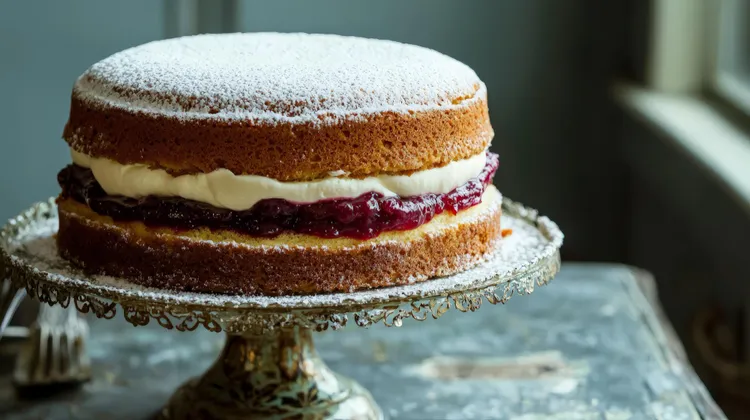
The Victoria sponge is the foundational British cake - not because it is the most spectacular or the most technically demanding, but because it is the one that most clearly demonstrates the principles of cake baking. Equal weights of butter, sugar, eggs, and self-raising flour. The creaming method. A simple filling of jam and cream. No decoration beyond a dusting of icing sugar.
It is also the cake that most immediately reveals whether your technique is correct. A well-made Victoria sponge is golden, level, with a light and tender crumb that springs back when pressed. An incorrectly made one is dense, heavy, pale, or collapsed - and each failure has a specific cause that understanding the method makes immediately diagnosable.
This post explains the method fully: what the creaming step achieves, why all the ingredients must be at room temperature, what self-raising flour does that plain flour doesn't, and how to tell when the cake is done without opening the oven door. By the end, you will not just follow this recipe - you will understand it well enough to adapt it to any sponge cake.
The Victoria Sponge Ratio: Why Equal Weights
The Victoria sponge ratio is one of the most elegant pieces of kitchen mathematics: equal weights of butter, sugar, eggs, and flour. A 3-egg cake uses 3 eggs, then weighs them (approximately 180g) and uses the same weight of each other ingredient.
This ratio is not an accident. Each ingredient plays a specific structural role:
Butter provides fat, which produces tenderness (fat inhibits gluten development), flavour, and moisture. It also traps air during creaming, which leavens the cake.
Sugar provides sweetness, but also structure (caramelisation during baking helps set the cake's surface), moisture retention (sugar is hygroscopic), and Maillard browning. Equal sugar to butter means enough to sweeten without over-sweetening.
Eggs provide protein (structure), fat (from the yolk - richness and emulsification), and water (moisture and steam leavening). Equal eggs to butter means sufficient structure to support the cake without making it rubbery.
Self-raising flour provides starch (structure and thickening) and pre-measured leavening (baking powder). Equal flour to butter means enough structure without making the cake dry or dense.
The balance of these four equal-weight ingredients produces a cake that is stable enough to hold its shape but tender enough to be pleasant to eat - the specific equilibrium that makes the Victoria sponge the standard.
The Creaming Method: Where the Leavening Begins
Unlike sourdough bread (leavened by yeast) or choux pastry (leavened by steam), a Victoria sponge is leavened primarily by mechanical air - air that is incorporated into the butter during the creaming step and that expands in the oven's heat to produce rise.
What creaming does: Beating room-temperature butter with sugar for 5-8 minutes creates a pale, fluffy, substantially increased-volume mixture. During this beating, the sugar crystals cut through the butter and create countless tiny air pockets. These air pockets are expanded by the heat of the oven, producing the light, even crumb of a well-made sponge.
Why temperature matters critically:
Room-temperature butter (approximately 20°C) creams effectively - it is soft enough to allow the sugar crystals to incorporate air but structured enough to hold the air pockets once created.
Cold butter (straight from the refrigerator) is too rigid - the sugar crystals cannot create air pockets efficiently. The result is dense.
Melted butter creates no air pockets at all - fat in liquid form cannot trap air. Using melted butter in a creamed cake recipe produces a dense, heavy result regardless of how long you beat it.
The eggs must also be at room temperature - cold eggs added to creamed butter cause the mixture to curdle (the fat contracts around the cold egg proteins), collapsing the air that was so carefully built. The cake can recover from slight curdling, but significant curdling produces a dense, uneven result.
Ingredients
Makes 2 × 20cm round cakes (1 sandwich) | Active time: 20 minutes | Total time: 50 minutes
- 3 large eggs, at room temperature (weigh them - approximately 165-180g)
- Equal weight unsalted butter (165-180g), at room temperature - genuinely soft, not cold
- Equal weight caster sugar (165-180g) - caster sugar (finer than granulated) creams more smoothly
- Equal weight self-raising flour (165-180g), sifted
- 1 tsp vanilla extract
- 1-2 tbsp whole milk - to adjust batter consistency if needed
The Filling
- 4 tbsp good strawberry or raspberry jam - ideally homemade or a quality brand with high fruit content
- 300ml double cream, whipped to soft peaks - or 150g clotted cream for a richer, more traditional option
- Icing sugar for dusting
Method
Step 1: Prepare tins and oven (5 minutes)
Preheat the oven to 170°C (fan). Grease two 20cm round sandwich tins and line the bases with parchment. Greasing the sides (not just the base) ensures the cake releases cleanly without tearing the edges.
Why fan oven at 170°C? A fan oven circulates hot air evenly around the cake, producing a level surface. A conventional oven (without fan) runs hotter at the top - use 180°C and place both tins on the same middle shelf. Cakes baked too hot rise rapidly then collapse; cakes baked too cool don't rise fully.
Step 2: Cream butter and sugar (5-8 minutes)
In the bowl of a stand mixer or using a hand mixer, beat the soft butter and caster sugar together on medium-high speed for 5-8 minutes until the mixture is:
- Noticeably pale - almost white
- Significantly increased in volume (roughly doubled)
- Fluffy and light in texture when a spatula is dragged through it
Do not rush this step. A 2-minute cream and a 7-minute cream produce detectably different results. Most home cooks under-cream. Use a timer.
Step 3: Add eggs (3 minutes)
Add the eggs one at a time, beating for 30-45 seconds after each addition before adding the next. Adding all the eggs at once can cause the mixture to curdle.
If the mixture shows signs of curdling (looking lumpy or separated rather than smooth and glossy) - add 1 tbsp of the measured flour. This tightens the emulsion and rescues the mixture.
Add the vanilla extract and beat briefly.
Step 4: Fold in the flour (1 minute)
Sift the flour directly over the creamed mixture. Using a large metal spoon or spatula, fold in with slow, deliberate strokes from the bottom of the bowl up and over the top - a figure-of-eight motion. The goal is to incorporate the flour without knocking out the air that was incorporated during creaming.
The metal spoon technique: A metal spoon cuts through the mixture more cleanly than a rubber spatula, producing slightly less air loss during folding. Either works; the metal spoon is the traditional choice.
The batter should drop from the spoon in a slow, reluctant fall - the "dropping consistency." If it is too stiff (it holds on the spoon and doesn't fall), add the milk 1 tbsp at a time until it reaches dropping consistency.
Step 5: Divide and bake (25-30 minutes)
Divide the batter equally between the two tins (weigh them for precision). Smooth the surface gently with the back of a spoon. Do not smooth too vigorously - the batter should just be level, not worked.
Bake for 22-25 minutes until:
- Golden-brown on the surface
- The edges are just pulling away from the sides of the tin
- A skewer inserted into the centre comes out clean
- The surface springs back immediately when gently pressed - this is the most reliable doneness test
Do not open the oven door in the first 15 minutes. The structure of a sponge is set by heat - opening the door allows cold air in and can cause the cake to deflate before it has set.
Step 6: Cool
Leave in the tins for 5 minutes, then turn out onto a wire rack. Remove the parchment. Allow to cool completely before filling - a warm sponge melts whipped cream and makes the sandwich difficult to assemble.
Step 7: Fill and finish
Place one cake layer on the serving plate, flat-side up. Spread the jam to within 1cm of the edge. Spread or pipe the whipped cream over the jam (or use clotted cream, spread generously). Place the second cake layer on top, flat-side down.
The flat-side-up technique: Baked cake layers have a domed top. Placing the bottom layer flat-side up and the top layer flat-side down produces a level sandwich that doesn't wobble or slide.
Dust generously with icing sugar through a fine sieve immediately before serving - icing sugar on a cream-filled cake absorbs into the surface within an hour.
The Filling Debate
Jam on the bottom, cream on top of the jam: The traditional order. The jam base anchors the cream and prevents it from sliding.
Jam in the cream layer: Some recipes mix a small amount of jam into the whipped cream. Produces a pink, lightly flavoured cream but a less distinct jam layer.
Which jam: Strawberry is traditional. Raspberry is marginally better - its slight tartness cuts through the richness of the cream and butter more effectively. Good-quality jam with actual fruit content makes a significant flavour difference.
Cream vs. clotted cream: Whipped double cream produces a lighter, airier filling. Clotted cream produces a richer, denser, more indulgent one that doesn't need whipping. Both are correct; the choice is personal.
Cream on top: The Women's Institute (the most authoritative body on Victoria sponge tradition) specifies no cream on top of the cake - icing sugar only. This is correct for a classic presentation. For a modern, more generous version, whipped cream swirls on top are an acceptable departure.
Variations
Lemon Victoria Sponge
Replace the vanilla with the zest of 2 lemons. Fill with lemon curd (the base from the Lemon Tart recipe) and whipped cream in equal proportions. Top with a lemon glacé icing (icing sugar + lemon juice). The lemon version has a brightness and sharpness that the vanilla original doesn't - a genuinely different cake.
Coffee and Walnut
Replace the vanilla with 2 tsp of instant espresso powder dissolved in 1 tsp of boiling water. Add 80g of finely chopped toasted walnuts to the batter. Fill with coffee buttercream (butter + icing sugar + espresso). Top with walnut halves. The most classically British variation after the original.
Chocolate Victoria Sponge
Replace 30g of the self-raising flour with 30g of cocoa powder. Fill with chocolate ganache and whipped cream. The cocoa reduces the leavening slightly - add ½ tsp of baking powder to compensate.
Pro Tips
- The butter must be genuinely soft. Press a finger into it - it should leave an immediate indentation with no resistance. If it's cold at all, the cream won't work. Leave it out of the refrigerator for 2 hours, or microwave in 5-second bursts until it gives to finger pressure.
- Weigh the eggs. Eggs vary significantly in size. A 3-egg cake where one egg is a small and two are large will have a different ratio than intended. Weigh them, use that number for all four ingredients.
- Measure the batter into the tins. A digital scale under each tin ensures equal layers that bake in the same time. Unequal layers produce one undercooked and one overcooked cake.
- The cake is done when it springs back. Press the surface of the cake gently with a finger. Immediate spring back = done. Slow spring = needs a few more minutes. No spring (the indentation remains) = significantly underbaked.
Common Mistake: Cold Eggs Cold eggs added to properly creamed butter cause the emulsion to break - the fat contracts and the mixture curdles into lumpy, separated-looking batter. The air incorporated during creaming escapes, and the cake is dense and uneven. The fix is always: eggs at room temperature. Leave them out for 1-2 hours alongside the butter, or warm them briefly in a bowl of warm water for 5 minutes. This one detail makes a more consistent difference to Victoria sponge success than any other single factor.
FAQ
Q: Can I use the all-in-one method instead of creaming?
The all-in-one method (all ingredients combined at once and beaten for 2 minutes) works and produces a good cake. It is faster and more forgiving - there's nothing to over-cream or curdle. The result is slightly denser and less airy than the properly creamed version. For a quick, reliable cake, it's excellent. For the lightest possible sponge, cream properly.
Q: Can I make this as a single layer rather than two tins?
Yes - bake in one 23cm round tin for approximately 30-35 minutes. The single, thicker cake won't have the sandwich element, but works well cut in half horizontally once cooled.
Q: Can I make this dairy-free?
Replace the butter with a good-quality vegan butter (Flora Plant or similar) used at room temperature - the creaming method works with most vegan butters. Replace the cream with whipped coconut cream (refrigerated overnight) or a good-quality vegan whipping cream. The result is close to the original, slightly less complex in flavour.
🔗 Continue Baking
Latest