Why Food Tastes Different on Aeroplanes
The food served on aeroplanes isn't nearly as bad as its reputation suggests - in many cases it's prepared by competent caterers and heated properly in flight. The problem isn't the food. It's you, temporarily transformed by altitude, pressurisation, low humidity, engine noise, and sensory isolation into a person with measurably different taste perception than the one who boarded the plane.
Here's something that sounds like an urban myth but is supported by solid research: tomato juice - a drink that most people consider slightly boring on the ground - is one of the most popular beverages on long-haul flights. Lufthansa famously reported selling as much tomato juice in the air as beer, despite beer outselling it dramatically on the ground. The flavour profile of tomato juice - savoury, umami-forward, slightly acidic - turns out to be almost perfectly suited to what happens to human taste perception at altitude.
This is not a coincidence. And understanding it reveals something genuinely surprising about how your senses work - and how fundamentally environmental conditions determine what food tastes like.
Food tastes different on aeroplanes primarily because the combination of low cabin pressure (equivalent to altitude of 6,000-8,000 feet / 1,800-2,400 metres), extremely low humidity (as low as 10-12%), background engine noise, and reduced smell from nasal congestion all simultaneously impair taste and smell perception. Studies suggest sweet and salty flavours are reduced by approximately 30% at altitude. Umami flavours are much less affected - which is why savoury, umami-rich foods like tomato juice taste comparatively better in the air than on the ground.
Five Forces Working Against Your Palate
Force 1: Cabin Pressure - The Atmosphere Your Palate Has Never Trained For
Commercial aircraft cabins are pressurised, but not to sea-level pressure. Standard cabin pressure is equivalent to the atmospheric pressure at approximately 6,000-8,000 feet (1,800-2,400 metres) above sea level - similar to being in a moderately high mountain town. This is a deliberate engineering compromise: fully pressurising to sea level would require significantly stronger and heavier fuselage construction.
At this reduced pressure, several physiological changes occur:
- Blood oxygen saturation decreases slightly, affecting neural processing throughout the body including the olfactory and gustatory systems.
- Gas in the body expands - which is why ears pop, feet swell, and the digestive system becomes more active.
- The taste receptor cells on the tongue are slightly less responsive at reduced atmospheric pressure - the physical mechanism is still being researched, but the effect on sweet and salty detection is consistently measurable in controlled studies.
Force 2: Low Humidity - Your Nose Stops Working
This is arguably the most significant factor. Aircraft cabins have extremely low relative humidity - typically 10-20%, compared to a comfortable indoor environment of 40-60%. Desert air is typically around 25%. The Sahara at its driest reaches approximately 15%. The cabin of a long-haul flight approaches conditions more arid than most deserts on earth.
The practical effect: the mucous membranes in your nose dry out rapidly. The mucous layer that normally coats the olfactory epithelium - the tissue in your nasal cavity that detects smell - thins and partially dries. Smell receptors that are normally submerged in mucus become exposed and less effective. The cilia that help transport aromatic molecules to the receptors function less efficiently in dry conditions.
This matters enormously because 80% of what we perceive as taste is actually smell. The experience of flavour is a combination of the five basic tastes detected by tongue receptors and the retronasal olfactory signal - the aromatic compounds that travel through the back of the throat up into the nasal cavity as you chew and swallow. When retronasal smell is impaired, the flavour complexity of food collapses dramatically.
The result: food that tastes complex and aromatic on the ground tastes flat and one-dimensional in the air - because the olfactory component of its flavour profile has been largely removed.
Force 3: Background Noise - Your Brain Changes How It Processes Taste
This finding from the research is perhaps the most counterintuitive: noise directly affects how food tastes. Studies by Charles Spence at Oxford University and others found that high levels of background noise measurably reduce the perception of sweetness and saltiness while simultaneously leaving umami perception largely intact and even slightly enhancing the perception of crunchiness.
The mechanism is psychological rather than physiological: the brain allocates attentional resources across all sensory inputs simultaneously. In a noisy environment, more neural processing is devoted to auditory input, and correspondingly less is available for gustatory and olfactory processing. The taste experience is literally reduced because the brain is busier listening than tasting.
The engine noise of a commercial aircraft - typically 80-85 decibels in the cabin - falls squarely in the range where these taste-suppression effects are most pronounced. This research also explains why food tastes better in a quiet restaurant than a loud one, and why background music affects food perception.
Force 4: Nasal Congestion - The Altitude Stuffiness That Isn't a Cold
Many passengers experience a blocked or congested feeling in their nose during flight, even when perfectly healthy. The low humidity and pressurisation changes cause nasal membranes to swell slightly - a physiological response to the dry, pressurised conditions that mimics mild nasal congestion. This further blocks the retronasal pathway through which aromatic compounds travel from the back of the throat to the olfactory receptors.
Combined with the humidity-related drying of the mucous layer, the effect is a nose that is simultaneously too dry in its mucous layer and too swollen in its membranes - blocking smell from two directions simultaneously.
Force 5: Psychological Context - Environment Shapes Expectation
The final factor is the most difficult to quantify but may be the most significant in practical terms: context shapes taste perception. Research in sensory psychology consistently shows that the same food tastes different depending on the environment - the colour of the room, the quality of the crockery, the lighting, and the expectations the diner brings to the meal.
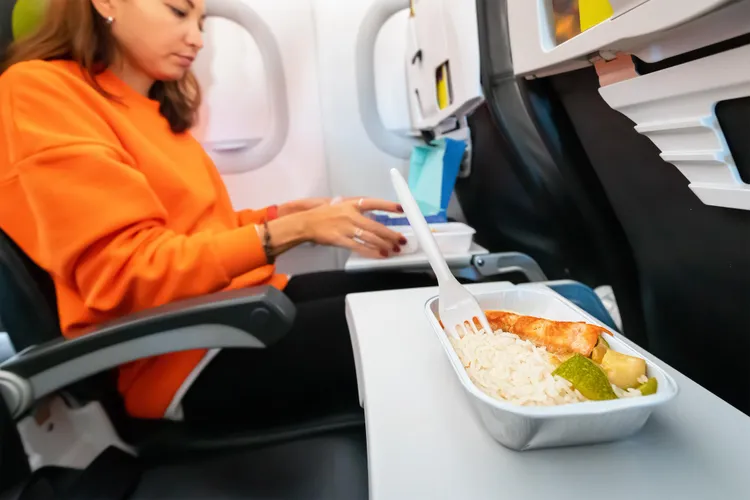
The interior of an aircraft cabin - its plastic trays, foil covers, clinical lighting, cramped seating, and general association with endurance rather than pleasure - primes the diner for a modest experience before a single bite is taken. This is the well-documented phenomenon of expectation shaping perception: the same glass of wine tastes measurably better in an expensive-looking glass than a cheap one. The same airline meal would taste measurably better served on china at a table with natural light.
"The problem with airline food isn't the food - it's that the aeroplane itself is one of the most hostile sensory environments a meal has ever been served in."
What Most People Get Wrong
| Myth | Fact |
|---|---|
| Airline food is bad because it's poor quality or badly cooked. | Most airline food is prepared by professional catering companies to reasonable standards, then chilled and reheated in flight. The flavour degradation is primarily a consequence of the sensory environment, not food quality. The same dish served in a restaurant would taste meaningfully better. |
| Tomato juice tastes good on planes because airlines use a better recipe. | Tomato juice tastes good on planes because its umami-forward, savoury flavour profile is among the least affected by altitude conditions. Sweet and salty are suppressed; umami is relatively preserved. Tomato juice is one of the few standard drinks that tastes as good or better at altitude than on the ground. |
| Alcohol affects you more at altitude because of the thinner air. | Alcohol absorption rates are not significantly different at cabin pressure. However, the dehydrating effects of alcohol are amplified by the already-extremely-low cabin humidity - you dehydrate faster, which affects how alcohol is metabolised. The effects feel stronger partly because baseline hydration is already compromised. |
| There is nothing you can do about how food tastes on a plane. | Several practical interventions work: staying well hydrated maintains nasal mucous function, choosing umami-rich foods works with your altered palate, noise-cancelling headphones reduce the auditory load suppressing taste processing, and saline nasal spray keeps olfactory membranes functioning closer to normal. |
| Wine always tastes terrible on planes. | Bold, tannic, high-acid wines fare significantly better than delicate, floral, or minerally styles. The latter category depends heavily on aromatic volatiles that are impaired by cabin conditions; the former relies more on the structural tastes (tannin, acid) that are less affected. Choose accordingly. |
The Umami Advantage: Why Some Foods Win at Altitude
The research consistently shows that umami is the taste least suppressed by altitude conditions. While sweet and salty drop by approximately 20-30%, umami perception remains largely intact or even slightly enhanced in some subjects. The reason may relate to umami's different receptor pathways and processing - pathways less affected by reduced pressure and noise-related attentional loading.
Foods and drinks that perform comparatively well at altitude:
- Tomato-based drinks and food (tomato juice, Bloody Mary, tomato-based sauces)
- Strongly savoury elements (aged cheese, cured meats, olives, pickled vegetables)
- Fermented and umami-rich ingredients (miso, soy sauce, Worcestershire sauce)
- Spiced preparations delivering flavour through chemical heat (chilli, black pepper, mustard) - heat-based flavour is less dependent on olfactory function than aromatic flavour
Foods and drinks that suffer most at altitude:
- Delicate, aromatics-dependent flavours (fine wine, fresh herbs, most desserts)
- Sweet preparations - chocolate, cake, sweet drinks taste noticeably flatter
- Fresh salad and raw vegetable flavours - largely aromatic, heavily olfactory-dependent
- Subtle, nuanced wines - delicate, floral styles are hit hardest
How to Eat and Drink Better on a Plane
Stay hydrated - this is the single most effective intervention
Hydration is the most impactful thing you can do for your taste perception in flight. The nasal mucous layer - the primary delivery mechanism for retronasal smell - requires adequate hydration to function. Dehydration worsens every flavour-impairing effect of the cabin environment. Drink water before you feel thirsty; thirst at altitude is a lagging indicator of dehydration that has already occurred.
Use noise-cancelling headphones during meals
The research on noise and taste perception is clear: reducing auditory load during eating makes a measurable difference to flavour perception. Noise-cancelling headphones reduce the dominant source of attentional competition for taste processing. Many frequent flyers report that food tastes noticeably better when eaten in comparative quiet - this is not placebo, it reflects the cross-modal sensory interaction documented in the research.
Choose umami-forward foods and drinks
Order the tomato juice. Choose the meal option with aged cheese, cured elements, or a strongly seasoned protein. Avoid the delicate dessert. Lean toward bold, savoury flavours and away from subtle, aromatic ones - they will perform better in the conditions your palate is operating under.
Consider a saline nasal spray
A simple isotonic saline spray used before and during a long flight keeps the nasal mucous membrane hydrated and maintains olfactory function closer to normal. Several airlines have investigated this as a recommendation for passengers; the logic is straightforward - maintain the mucous layer, maintain smell, maintain flavour.
Save the special wine for the ground
A fine bottle opened at home will taste dramatically better than the same bottle on a plane. The aromatic complexity that makes exceptional wine worth drinking is precisely the category most compromised by altitude conditions. Save the special bottle for a table where your senses are intact.
How Airlines Actually Design Food for Altitude
The more sophisticated airlines - particularly Singapore Airlines, Cathay Pacific, and Lufthansa - commission food science research specifically to understand how altitude conditions affect taste, and design their menus accordingly.
Singapore Airlines, in partnership with food science researchers, has conducted testing of dishes in altitude-simulating chambers to understand how flavours change between ground level and cruising altitude. Their menu development explicitly accounts for the suppression of sweet and salty flavours, with dishes designed to taste balanced at altitude rather than on the ground - which means they are deliberately over-seasoned and umami-amplified compared to what would taste correct in a restaurant.
The Lufthansa tomato juice phenomenon is not accidental. The airline studied in-flight beverage consumption data, found the tomato juice disparity significant enough to investigate, and the findings aligned with the umami research: its glutamate-heavy flavour profile makes it one of the rare standard beverages that tastes genuinely good at altitude.
This is applied food science that most passengers are entirely unaware of - the best airline food is not trying to taste good on the ground. It has been engineered to taste good at 35,000 feet, in conditions that are systematically hostile to normal flavour perception.
The humidity inside a commercial aircraft cabin - typically 10-12% relative humidity - is significantly lower than the inside of most office buildings, homes, or even the driest inhabited regions on earth. The recommended indoor relative humidity for human comfort and health is 40-60%. The Atacama Desert in Chile - the driest place on earth - has an average humidity of around 15-20%. This means that for the duration of a long-haul flight, your nose and throat are operating in conditions drier than the driest desert on the planet. Skin dries noticeably. Contact lenses become uncomfortable. The mucous layer your olfactory system depends on for detecting smell progressively desiccates. The reason airline food tastes bland is partly that you've been sitting in conditions drier than the Atacama for six hours - and nobody told your nose to prepare for it.
Here's What It All Comes Down To
Airline food tastes different - often worse - because five simultaneous environmental factors impair taste and smell perception: reduced cabin pressure, extreme dryness that compromises olfactory function, engine noise that competes for neural processing, nasal congestion from pressurisation changes, and psychological context primed for low-quality eating.
Sweet and salty flavours are reduced by approximately 30%. Umami is relatively preserved - which explains the tomato juice phenomenon and the relative success of strongly savoury foods at altitude. The food itself is often better than its reputation. The environment is the problem.
The practical response: stay hydrated, use noise-cancelling headphones during meals, choose umami-forward foods and drinks, consider a nasal spray on long flights, and save the delicate wine for a table on the ground where your senses are working as nature intended.
Key Takeaways
- Food tastes different on planes due to five simultaneous factors: reduced cabin pressure (~6,000-8,000 ft equivalent), extremely low humidity (10-20%), loud engine noise (~80-85 dB), nasal congestion from pressurisation, and psychological context.
- Cabin humidity - as low as 10-12% - is drier than most deserts on earth, causing the nasal mucous membrane to dry and significantly impairing smell, which accounts for approximately 80% of perceived flavour.
- Background engine noise measurably reduces sweet and salty taste perception - the brain allocates attentional resources to auditory processing, leaving less for taste.
- Sweet and salty flavours are suppressed by approximately 20-30% at altitude. Umami is the least affected taste - which explains why tomato juice, aged cheese, and savoury foods taste comparatively better in the air.
- Lufthansa sells as much tomato juice as beer on its flights - the data that led to food science investigation and confirmed the umami advantage at altitude.
- Noise-cancelling headphones during meals measurably improve taste perception by reducing auditory load competing with gustatory processing.
- The best airlines deliberately over-season and umami-amplify their food for altitude - designing dishes to taste balanced at 35,000 feet, not on the ground.
- Cabin humidity is lower than the Atacama Desert - the driest place on earth - for the entire duration of a long-haul flight.
Latest