Chocolate Truffles: The Ganache Method
The cream-to-chocolate ratio that produces rollable ganache, five flavour variations, and the coating technique for a professional finish
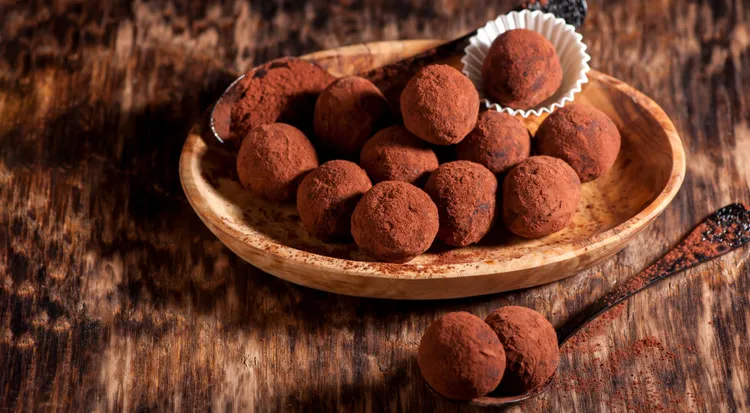
A chocolate truffle is ganache - chocolate and cream emulsified together - chilled until firm enough to roll into balls, then coated in cocoa powder, chocolate, or another coating. It is one of the most straightforward preparations in chocolate confectionery, and one that produces something of genuine quality with ingredients costing approximately £5-8 for a batch of 30 truffles.
The skill is in the ganache ratio. Too much cream: the ganache remains too soft to roll. Too much chocolate: it becomes hard and crumbly rather than smooth and rollable. The ratio in this recipe is specifically calibrated for a ganache that is firm enough to hold its shape after rolling but soft enough to melt immediately on the tongue.
The Ganache Science
Ganache is an emulsion - liquid (cream) dispersed throughout fat (cocoa butter). When the ratio is correct, the ganache is smooth, glossy, and temperature-sensitive: liquid when warm, firm when cold.
For truffles: The ideal ganache is rolled when cold (firm) and eaten at room temperature (soft and melting). This requires a cream-to-chocolate ratio of approximately 1:2 by weight - 100ml of cream to 200g of chocolate. This is slightly stiffer than a pourable ganache sauce but softer than a ganache used for coating cakes.
Base Ingredients
Makes approximately 30 truffles | Active time: 20 minutes | Chilling: 2 hours minimum
- 300g dark chocolate (70%), finely chopped - quality chocolate here is essential; the truffle is the chocolate
- 150ml double cream
- 30g unsalted butter, at room temperature - adds smoothness and gloss
- Pinch of fine salt - amplifies the chocolate flavour
For rolling and coating:
- 50g good-quality cocoa powder - sifted, for dusting (the traditional coating)
- OR 200g dark chocolate, tempered (for a chocolate shell coating)
- OR 100g finely chopped toasted nuts, freeze-dried raspberry powder, shredded coconut
Base Method
Step 1: Make the ganache
Place the finely chopped chocolate in a heatproof bowl.
Heat the cream in a small saucepan until just simmering - small bubbles forming at the edges, steaming. Do not boil.
Pour the hot cream over the chocolate. Leave for 90 seconds without stirring - the residual heat melts the chocolate from below. Then stir gently from the centre outward in small circles, gradually expanding, until the mixture is completely smooth and glossy.
Add the room-temperature butter. Stir until completely melted and incorporated. Add the salt.
The ganache should be: Smooth, very glossy, completely uniform. If there are any visible chocolate pieces: the cream wasn't hot enough. Return the bowl to a bain-marie for 30 seconds and stir again.
Step 2: Chill the ganache
Pour the ganache into a shallow container (a 20×20cm square tin or a plate with edges). Smooth the top. Press cling film directly against the surface.
Refrigerate for 2 hours until firm enough to scoop - it should hold a spoon impression but still yield. Over-chilled ganache (more than 4 hours) becomes too firm to roll smoothly and may crack - remove from the refrigerator 10 minutes before rolling if very firm.
Step 3: Portion and roll
Use a melon baller, a small ice cream scoop, or two teaspoons to portion the ganache into approximately 15-18g balls - roughly the size of a large cherry.
Work quickly - the warmth of your hands melts the ganache. Roll each portion briefly between your palms to form a rough ball. Place on a parchment-lined tray. Refrigerate for 15 minutes to re-firm.
Smooth rolling: For a rounder, more regular shape, roll each truffle a second time after the 15-minute re-firming, when the outer surface has set.
Step 4: Coat
Cocoa powder coating (traditional): Sift the cocoa powder into a shallow bowl. Drop each truffle into the cocoa. Roll to coat completely. Tap off any excess. The cocoa coating absorbs some moisture from the ganache over time - coat immediately before serving or storage for the most even result.
Chocolate shell coating (professional): For a chocolate shell rather than a cocoa dusting, the chocolate must be tempered - brought to specific temperatures to ensure the cocoa butter crystallises in the correct form, producing a shiny, snapping chocolate shell. See the tempering note below.
Nut or decoration coating: Roll the truffle in finely chopped toasted hazelnuts, almonds, or pistachios. Or roll in freeze-dried raspberry powder (vivid pink, intensely flavoured). Or desiccated coconut. These coatings are applied before the chocolate shell if using both.
Five Flavour Variations
1. Classic Dark Chocolate
The base recipe with no additions. The quality of the 70% chocolate is the entire flavour.
2. Raspberry
Add 2 tbsp of raspberry purée (fresh raspberries blended and strained) to the cream before heating. The raspberry adds tartness and fruit that cuts the chocolate's richness. Coat in freeze-dried raspberry powder for a vivid pink exterior.
3. Espresso
Dissolve 1 tbsp of instant espresso in 1 tbsp of the hot cream before combining with the chocolate. The espresso deepens the chocolate flavour without adding a specific coffee note at low quantities - at the full tablespoon, the coffee flavour is clearly present and excellent.
4. Sea Salt and Caramel
Replace 30g of the double cream with 30g of salted caramel sauce (from the Sticky Toffee Pudding recipe or the Panna Cotta topping variation). Add the caramel to the melted chocolate along with the cream. Coat in flaky sea salt (a few flakes on top of the cocoa powder coating).
5. Matcha
Add 2 tsp of ceremonial-grade matcha powder, mixed to a smooth paste with 1 tbsp of the cream, to the ganache. Reduce the dark chocolate to 250g and add 50g of good-quality white chocolate to balance the bitterness. Roll in a mixture of cocoa powder and matcha powder (50/50). See The Complete Matcha Guide.
Tempering Note (For Chocolate Shell Coating)
Tempering is the process of bringing chocolate to specific temperatures to produce the correct cocoa butter crystal structure - resulting in a glossy, snapping shell rather than a dull, soft coating. For home use without specialist equipment:
Simple seeding method: Melt 200g of finely chopped dark chocolate to 50°C. Remove from heat. Add 50g of additional finely chopped chocolate (at room temperature) and stir until melted and the temperature drops to 32°C. The added chocolate "seeds" the correct crystal form. Work quickly - dip the chilled truffles into the tempered chocolate using a fork or dipping tool, tap off excess, and place on parchment to set.
Storing and Shelf Life
Cocoa-coated truffles: 2 weeks in the refrigerator, covered. Allow to come to room temperature (15 minutes) before serving - cold truffles don't melt on the tongue in the same way.
Chocolate shell-coated truffles: 3 weeks refrigerated.
Gifting: Truffles in a small box lined with parchment, presented in individual petit four cases, make an excellent homemade gift. The cost for a box of 20 high-quality truffles is approximately £4-6 in ingredients.
Pro Tips
- Chop the chocolate finely. Coarse pieces don't melt fully in the cream. Fine chopping ensures complete melting.
- Don't overheat the cream. Hot cream produces a smooth ganache. Boiling cream can cause the fat in the cream to separate slightly, producing a greasy ganache.
- Cold hands or cold tools. Warm hands melt the ganache during rolling. Work quickly, chill your hands in cold water (then dry completely) between batches, or use two cold spoons rather than rolling with your palms.
- Make a double batch. The active time is the same for 30 or 60 truffles. Truffles store well and make excellent gifts. Doubling is almost always the right decision.
🔗 More Chocolate Desserts
Latest