One-Pan Pork Tenderloin with Apple and Sage
The fastest-cooking large protein - seared, oven-finished, and served with caramelised apple and cider pan sauce in 35 minutes
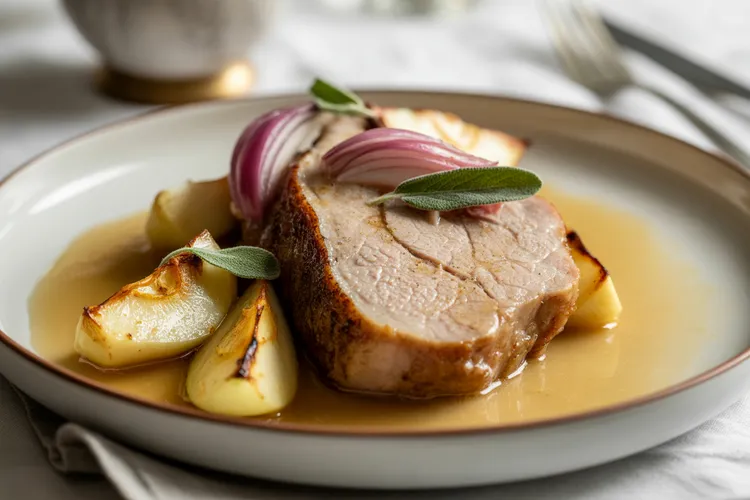
Pork tenderloin is one of the great underutilised cuts in the home kitchen. It is the fastest-cooking large protein available - a 400g tenderloin goes from raw to perfectly cooked in under 25 minutes. It is lean and flavourful with none of the texture issues of pork loin (which dries out easily). And it is remarkably affordable for what it produces on the plate.
The challenge with tenderloin is its speed - precisely because it cooks fast, it can overcook equally fast. The window between perfect (63°C internal, slightly pink, juicy) and overcooked (74°C+, grey throughout, dry) is narrower than for most proteins. A thermometer is the difference between a memorable dinner and a disappointing one.
This recipe is built for autumn - caramelised apple wedges, sage brown butter, and a cider pan sauce that caramelises the fond from the sear into something extraordinary. But it is also a template: the technique (sear, oven-finish, rest, pan sauce) works across seasons and with any of the flavour variations at the end of this guide.
The Technique: Sear, Oven-Finish, Rest
Pork tenderloin is too thick to cook through entirely on the hob at the temperature needed for a good crust (the outside would burn before the centre is cooked). Too thin to roast from raw in the oven at a reasonable temperature without developing a pale, unbrowned exterior.
The solution is the two-stage method: sear on the hob to develop colour and flavour on the exterior, then finish in the oven at moderate heat for the interior to come up to temperature gently and evenly.
Stage 1 - Sear (3-4 minutes): Very high heat, a small amount of fat. Roll the tenderloin continuously so every surface browns. The goal is not to cook the pork through - it is to develop a golden-brown crust on every surface. This takes 3-4 minutes.
Stage 2 - Oven finish (15-18 minutes at 200°C fan): The oven's gentle, even heat brings the interior to the target temperature (63°C) without burning the exterior. The cast iron skillet retains its heat through the transfer, so the searing of the exterior continues slightly in the first minutes in the oven.
Stage 3 - Rest (7 minutes): The most important stage. Resting allows the juices to redistribute through the meat and the carry-over cooking to finish the centre gently. A pork tenderloin pulled from the oven at 60°C and rested for 7 minutes arrives at the table at exactly 63°C - perfectly cooked, slightly pink, consistently juicy throughout.
On the Internal Temperature
In many countries, pork tenderloin is still cooked to 74°C+ - the legacy of historical concerns about trichinosis, a parasitic disease from pork that has been effectively eliminated in modern commercial pork production through feed management and temperature control in food processing.
Modern food safety guidelines in the UK, US, EU, and most developed countries now recommend pork tenderloin cooked to 63°C internal temperature (followed by a 3-minute rest) - a point at which the meat is safe, slightly pink, and retains its full juiciness. This is the temperature used in this recipe.
Cooking to 74°C is not wrong - it is a matter of preference. At 74°C, the pork will be fully grey throughout and noticeably drier. At 63°C it is slightly pink at the centre, tender, and juicy. Both are safe. The choice is a flavour and texture preference.
Ingredients
Serves 4 | Active time: 15 minutes | Total time: 35 minutes
The Pork
- 1 pork tenderloin (approximately 500-550g), silverskin removed
- 1 tsp fine sea salt and ½ tsp black pepper
- 1 tsp dried sage and ½ tsp garlic powder - dry rub
- 1 tbsp neutral oil for searing
The Apple and Aromatics
- 2 eating apples (Cox, Braeburn, or Granny Smith - firm varieties that hold their shape during roasting), cored and cut into wedges
- 1 medium red onion, cut into wedges
- 8 fresh sage leaves
- 2 tbsp unsalted butter
- Salt and pepper
The Pan Sauce
- 200ml dry cider (or dry white wine)
- 1 tsp dijon mustard
- 1 tbsp cold unsalted butter
- Salt and pepper
Method
Step 1: Prepare the pork (5 minutes)
Remove the silverskin - the thin, pearlescent membrane running along one side of the tenderloin. Slide the tip of a thin knife under the silverskin, angle slightly upward, and use long strokes to separate it from the meat. Removing it is important: silverskin does not dissolve during cooking and contracts, distorting the shape of the tenderloin and creating a chewy band in the finished dish.
Pat the tenderloin dry. Combine salt, pepper, dried sage, and garlic powder, and rub over the entire surface.
Step 2: Preheat the oven and prepare the vegetables
Preheat to 200°C (fan). Toss the apple wedges and onion with 1 tbsp olive oil, salt, and pepper in a bowl. Set aside.
Step 3: Sear the pork (4 minutes)
Heat 1 tbsp of neutral oil in a cast iron skillet over high heat until just smoking. Place the pork tenderloin in the pan - it should sizzle loudly.
Roll the pork every 45-60 seconds, searing every surface - top, bottom, and both curved sides - for a total of 3-4 minutes. The exterior should be golden-brown all over. Thin ends will be more coloured than the thick centre - this is correct and fine.
Remove the pork temporarily to a plate.
Step 4: Build the apple and begin the oven stage
Reduce the heat to medium. Add 2 tbsp of butter to the same skillet. Once foaming, add the apple wedges and onion cut-side down. Cook undisturbed for 2-3 minutes until golden on the cut surfaces. Add the fresh sage leaves and cook for 30 seconds - they will sizzle in the butter and become fragrant.
Nestle the seared pork tenderloin on top of or alongside the apple and onion in the skillet. Transfer to the preheated oven.
Step 5: Oven-finish (15-18 minutes)
Roast until the internal temperature at the thickest point of the tenderloin reads 60°C - it will rise to 63°C during resting (carryover cooking).
Check at 15 minutes. If not yet at 60°C, return for 3-minute intervals, checking each time.
The visual indicators: The pork should be golden-brown all over, slightly firm when pressed at the thickest point (like a firm handshake rather than a soft squeeze), and the apple wedges should be golden and caramelised at the edges.
Step 6: Rest the pork (7 minutes)
Transfer the pork to a warm plate or cutting board. Tent loosely with foil. Leave the apple, onion, and sage in the skillet.
Rest for 7 minutes - non-negotiable. The juices redistribute; the carry-over cooking finishes the interior. The 7 minutes produces the difference between dry pork and juicy pork.
Step 7: Make the pan sauce (4 minutes)
While the pork rests, make the pan sauce. Return the skillet (with the apple and onion) to medium heat on the hob.
Pour in the cider. It will sizzle immediately against the hot pan. Scrape the bottom of the pan with a wooden spoon to release any fond. Add the dijon mustard and stir to incorporate.
Simmer for 3-4 minutes until the cider has reduced by half and the sauce is slightly syrupy. The apple releases some of its pectin into the sauce as it simmers - this helps the sauce thicken naturally.
Remove from heat. Add the cold butter and swirl the pan until it melts into the sauce. Taste and adjust seasoning.
Step 8: Slice and serve
Slice the rested pork tenderloin into 2cm medallions on a slight diagonal - the angled cut produces larger, more visually impressive slices than a straight cut.
The pork should be slightly pink at the centre - pale pink, not red or raw-looking. The juices should run clear. This is correct doneness.
Arrange the sliced pork in the skillet over the apple and onion, or plate individually with the apple and sauce spooned alongside. Serve immediately.
Variations
Fennel and Orange
Replace apple with 2 fennel bulbs (cut into wedges) and 1 orange (sliced into rounds). Replace cider with fresh orange juice. Replace sage with fresh thyme. The anise sweetness of fennel and the citrus brightness of orange complement pork tenderloin in a direction that feels Italian rather than British autumnal.
Mustard and Cream
Skip the apple. Sear the pork as above, then nestle into a bed of halved shallots and garlic cloves. After the oven stage, deglaze with white wine. Add 3 tbsp of dijon mustard and 100ml of crème fraîche to the reduced wine. A richer, more French-inspired version that is excellent with roasted potatoes.
Asian-Inspired: Ginger, Honey, and Soy
Dry rub: Replace the sage and garlic powder with 1 tsp five-spice powder and ½ tsp ground ginger.
No apple. Instead, after searing, brush the pork with a glaze of 2 tbsp soy sauce + 1 tbsp honey + 1 tsp sesame oil. Arrange around halved pak choi and spring onion. Pan sauce: Deglaze with 2 tbsp soy + 100ml chicken stock + 1 tsp rice vinegar. Finish with a few drops of sesame oil. Serve with steamed rice.
Pro Tips
- Remove the silverskin - it is not optional. Silverskin left on a pork tenderloin contracts during cooking, causing the tenderloin to curl and distort, and produces a chewy, unpleasant strip in the finished dish. The 2-minute removal is essential.
- Use a thermometer. Pork tenderloin at 55°C looks almost identical to pork tenderloin at 70°C from the outside. The difference is entirely in the texture of the interior - and the only way to know is to measure. A £10 instant-read thermometer removes all guesswork.
- Roll during searing, don't flip. Unlike a steak, which has two flat sides, a pork tenderloin is cylindrical. Rolling it continuously during the searing stage ensures every surface gets colour - not just the two largest sides.
- Firm eating apples only. Soft, floury apples (Golden Delicious, certain Cox varieties) dissolve during roasting. Cox, Braeburn, Fuji, and Granny Smith hold their shape and caramelise properly at the edges. Granny Smith provides the most acidity (which balances the pork's richness best); Cox provides the most sweetness.
Common Mistake: Overcooking Past 70°C Pork tenderloin at 74°C - the temperature many cooks still aim for from habit or caution - is noticeably drier and less interesting than pork at 63°C. Modern food safety guidelines confirm that 63°C (with 3-minute rest) is safe for pork tenderloin. Pull it at 60°C internal temperature, rest it for 7 minutes, and serve it slightly pink. Trust the thermometer. This is what properly cooked pork tenderloin tastes like.
FAQ
Q: Can I use pork loin instead of tenderloin?
Yes, with timing adjustments. Pork loin is larger and denser - a 1kg loin will need 25-30 minutes in the oven rather than 15-18. The same sear-oven-rest technique applies. Pork loin is less forgiving than tenderloin (it dries out more readily) - the thermometer becomes even more important.
Q: My pan sauce is too thin. How do I fix it?
Remove the apple and onion with a slotted spoon and simmer the sauce alone over medium-high heat for 3-5 more minutes until it reaches the consistency you want. Return the apple and onion to the pan. The apple pectin in the sauce means it thickens more as it reduces - be patient rather than adding flour or cornflour.
Q: Can I prepare the pork ahead?
The dry-brine stage (salt rub applied to the pork, left uncovered in the fridge for up to 24 hours) significantly improves the crust and seasoning depth. Apply the salt rub the night before and refrigerate uncovered. Remove from the fridge 30 minutes before cooking. The apple and onion prep can be done a few hours ahead.
Q: What should I serve alongside?
The pan sauce and the apple and onion are sufficient as accompaniments for a light meal. For a more substantial dinner: roasted new potatoes (from the Sheet Pan Salmon recipe timing), simple green beans, or a quick sauté of kale or cavolo nero alongside. The cider pan sauce is also excellent with mashed potato - a generous spoonful over the mash.
🔗 Continue Cooking
- One-Pot Beef Stew: The Sunday Classic Made Easy
- One-Pan Lemon Garlic Chicken Thighs with Roasted Vegetables
- Sheet Pan Sausage and Vegetables: The Ultimate Sheet Pan Dinner
- The Best Pans for One-Pan Cooking: An Honest Buyer's Guide
- The One-Pan Dinner Formula
- One-Pan & One-Pot Dinners: The Ultimate Guide
Latest