One-Pot Rice Dishes from Around the World: 5 Recipes
From the Spanish arroz con pollo to Jamaican rice and peas - five ways the world cooks rice in a single pot
Rice feeds more than half of the world's population. It appears in some form in almost every culinary tradition on earth. And across those traditions - from Japan to Jamaica, Iran to India, Spain to sub-Saharan Africa - the one-pot rice dish is a constant. Protein and aromatics and rice cooked together in a single vessel, where the rice absorbs the flavour of everything around it and the whole becomes significantly greater than the sum of its parts.
This collection brings five of those traditions together. Each dish is complete, distinctive, and representative of a genuine culinary approach - not a generalised "rice with stuff" but a specific preparation with its own technique, its own flavour vocabulary, and its own cultural context. Five different pots. Five different methods. One universal principle: rice cooked in a flavoured liquid produces something that neither the rice nor the liquid produces alone.
Recipe 1: Arroz con Pollo (Spain)
"Chicken with Rice" - but not like any chicken and rice you've had
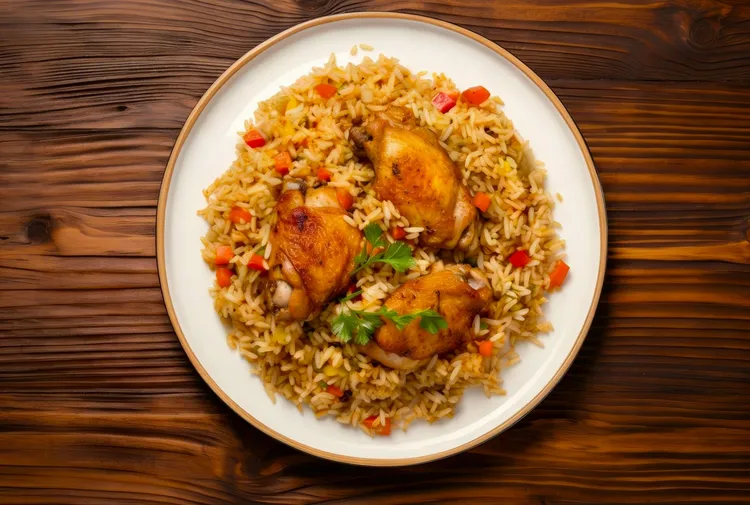
Arroz con pollo is one of the foundational dishes of Spanish home cooking - a one-pot preparation of chicken, saffron-scented rice, and vegetables that appears in some form across the Iberian Peninsula, Latin America, and the Spanish diaspora worldwide. Every family has a version. Every version is slightly different. All of them are good.
The Spanish approach differs from other one-pot chicken and rice dishes in one important way: the rice is added to the pot after the chicken and vegetables have been cooking for some time, absorbing a liquid that is already deeply flavoured from the chicken and sofrito. The rice doesn't just cook in the presence of the chicken - it cooks in liquid that has been building flavour for 20 minutes before the rice arrives.
Serves 4 | Total time: 60 minutes
Ingredients
- 4 bone-in chicken pieces (thighs and drumsticks), patted dry and seasoned generously
- 300g short-grain or bomba rice (paella rice is ideal; the short grain absorbs liquid particularly well)
- 1 medium onion, finely diced
- 2 cloves garlic, minced
- 1 red pepper, diced
- 400g tinned tomatoes, crushed
- 700ml hot chicken stock
- Large pinch of saffron threads, dissolved in 3 tbsp hot water
- 1 tsp smoked paprika
- ½ tsp turmeric - for additional colour
- 100ml dry white wine
- 3 tbsp olive oil
- Salt and pepper
- Fresh parsley to finish
Method
Heat olive oil in a wide, deep pan or Dutch oven over medium-high heat. Season and sear the chicken pieces skin-side down for 6-8 minutes until deeply golden. Remove and set aside.
In the same pan, sauté onion and pepper for 5 minutes until softened. Add garlic, paprika, and turmeric - cook 1 minute. Add wine and let it reduce for 2 minutes. Add tomatoes and cook for 5 minutes until slightly thickened.
Return the chicken to the pan. Add the hot stock and saffron water. Bring to a simmer, cover, and cook for 20 minutes.
Remove the chicken briefly. Add the rice, stirring to distribute. Nestle the chicken back on top. Cover and cook for 18-20 minutes until the rice has absorbed the liquid and is cooked through. Rest covered for 10 minutes. Finish with fresh parsley.
The cultural note: In Spain, arroz con pollo is the definitive family Sunday lunch - made in large quantities, eaten slowly, the pot placed in the centre of the table. The slightly golden, slightly crusty rice at the base of the pot (the socarrat - see the One-Pot Chicken and Rice post) is the most prized element.
Recipe 2: Sabzi Polo (Persian Herb Rice)
The green rice of Persian New Year - fragrant, vivid, and unexpectedly complex
Sabzi polo - literally "herb rice" - is the traditional rice dish of Nowruz (Persian New Year), served with fried fish (mahi) or, outside the traditional season, with white beans or lamb. The rice is layered with fresh herbs - dill, parsley, coriander, and sometimes fenugreek - and cooked in the Persian method, which produces something quite different from other rice preparations: a beautifully fluffy interior and a golden, slightly crispy crust at the base called tahdig.
The tahdig is to Persian cooking what the socarrat is to Spanish - the most prized element of the dish, the sign of a skilled cook, and the piece everyone reaches for first.
Serves 4 | Total time: 50 minutes (plus 30 minutes soaking)
Ingredients
- 400g basmati rice, rinsed and soaked in cold salted water for 30 minutes
- Large bunch fresh dill, finely chopped (about 40g)
- Large bunch fresh parsley, finely chopped (about 30g)
- Large bunch fresh coriander, finely chopped (about 30g)
- Optional: 2 tbsp dried fenugreek leaves (methi) - adds a distinctive, slightly bitter note authentic to the Iranian version
- 60g unsalted butter or 4 tbsp neutral oil
- Salt
- 1-2 tbsp rose water (optional - some regional versions include it)
Method
Bring a large pot of heavily salted water to a boil (saltier than you'd use for pasta - it should taste like mild seawater). Add the drained soaked rice and cook for 5-6 minutes until just barely parboiled - the outside is cooked and the rice bends without snapping, but the centre is still white and firm. Drain immediately.
Mix the parboiled rice with all the chopped herbs.
Return the empty pot to medium heat. Add 3 tbsp of butter and allow to melt and foam. You can line the base with sliced potato, flatbread, or just use the butter directly - all produce slightly different versions of tahdig.
Pile the herb rice loosely into the pot in a mound (do not press down - loose piling allows steam to circulate). Make a few holes in the mound with the handle of a wooden spoon for steam to escape. Drizzle remaining butter over the top.
Cover the pot lid with a clean tea towel, then place the lid on top (the cloth absorbs steam, keeping the rice dry and fluffy). Cook over medium heat for 5 minutes until the base begins to sizzle, then reduce to very low heat for 30-35 minutes until the rice is cooked through and the base has crisped.
Invert onto a plate to reveal the tahdig, or serve from the pot with the tahdig portion scooped out separately.
The cultural note: Sabzi polo is inseparable from Nowruz - the Persian New Year celebrated around the spring equinox. The green herbs represent renewal and the arrival of spring. It is the meal around which an entire cultural tradition of celebration is built.
Recipe 3: Jeera Rice with Simple Dal (India)
The everyday meal of a billion people - and one of the most satisfying one-pot combinations
Jeera rice (cumin rice) is the simplest and most widely eaten flavoured rice in Indian cooking - basmati rice cooked with whole cumin seeds that pop and release their warm, earthy fragrance into every grain. Served alongside a simple yellow dal (lentil soup), it is the foundational everyday meal of northern India: complete, nourishing, deeply satisfying, and entirely achievable in one pot (two pots if you make them simultaneously, though each is simple enough).
Serves 4 | Total time: 35 minutes
The Jeera Rice
- 300g basmati rice, rinsed until clear
- 1.5 tsp whole cumin seeds
- 1 bay leaf
- 2 green cardamom pods, lightly crushed
- 1 tbsp ghee (or neutral oil)
- 500ml hot water or light chicken/vegetable stock
- 1 tsp salt
The Simple Dal (same pot, cooked first)
- 200g red lentils, rinsed
- 700ml water
- 1 tsp ground turmeric
- 1 tsp salt
- The tarka: 2 tbsp ghee, 1 tsp whole cumin seeds, 3 cloves garlic (sliced), 2 dried red chilies, ½ tsp asafoetida - all fried together in ghee for 60 seconds until fragrant, then poured sizzling over the cooked dal
Method for Jeera Rice
Heat ghee in a heavy-based saucepan over medium heat. Add the whole cumin seeds - they should sizzle immediately in the hot fat. Cook for 30-45 seconds until they darken slightly and the kitchen smells intensely of toasted cumin. Add cardamom pods and bay leaf, cook 15 seconds.
Add the rinsed rice and stir for 1 minute to coat in the spiced ghee. Add the hot water and salt. Bring to a boil, then cover tightly and reduce to the lowest heat. Cook for 12 minutes undisturbed. Remove from heat and rest covered for 5 minutes. Fluff with a fork.
Method for Dal
Simmer lentils with water and turmeric for 20 minutes until completely soft. Make the tarka (tempering) in a separate small pan: heat the ghee until smoking, add cumin seeds, garlic, dried chilies, and asafoetida in quick succession - stand back, it will spit. Pour the sizzling tarka over the dal immediately. Stir and taste.
The cultural note: Dal-chawal (dal and rice) is the meal that sustains northern India. It is the food people return to after eating away from home. It is, for hundreds of millions of people, the taste of comfort.
Recipe 4: Takikomi Gohan (Japan)
Autumn rice - seasonal ingredients absorbed into every grain
Takikomi gohan is the Japanese one-pot rice dish where ingredients are cooked directly with the rice in dashi - the foundational Japanese stock - so every grain absorbs the flavours of the mushrooms, vegetables, and sometimes chicken or seafood added alongside. It is an autumn and winter dish traditionally, made with the season's ingredients: mushrooms, burdock root, chicken, carrots.
Unlike most rice dishes in this collection, takikomi gohan is made with Japanese short-grain rice, which absorbs liquid differently from basmati or long-grain rice - producing a stickier, more cohesive result where the grains cling slightly, making it easier to eat with chopsticks and giving it a different, more substantial mouthfeel.
Serves 4 | Total time: 45 minutes (plus 30 minutes soaking)
Ingredients
- 300g Japanese short-grain rice (sushi rice), rinsed until the water runs clear and soaked in cold water for 30 minutes
- 150g shiitake mushrooms (fresh or rehydrated from dried), thinly sliced
- 150g boneless chicken thigh, cut into 1-2cm pieces (optional - omit for vegetarian)
- 1 medium carrot, cut into matchsticks or thin rounds
- 2 tbsp soy sauce
- 2 tbsp mirin
- 1 tbsp sake (or dry sherry)
- 350ml dashi (kombu and bonito - or kombu-only for vegetarian; see Essential Asian Street Food Pantry and Matcha Miso Soup for dashi guidance)
- Spring onions and toasted sesame seeds to finish
Method
Drain the soaked rice and place in a rice cooker or heavy saucepan. Add the dashi, soy sauce, mirin, and sake - stir gently. Taste the liquid: it should be lightly seasoned, savoury, and slightly sweet from the mirin.
Arrange the mushrooms, chicken (if using), and carrot on top of the rice - do not stir them in. The ingredients steam above the rice during cooking and their juices drip down into the rice.
In a rice cooker: Use the standard cook setting. The rice cooker handles the rest.
On the hob: Bring to a boil over medium-high heat, cover, reduce to very low heat, and cook for 15 minutes. Remove from heat and rest covered for 10 minutes.
Stir gently to distribute the ingredients through the rice. Finish with sliced spring onion and sesame seeds.
The cultural note: Takikomi gohan is seasonal food in the truest sense - it changes with what is available, reflecting the Japanese principle of shun (eating things at their seasonal peak). Autumn takikomi gohan with matsutake mushrooms is one of the most celebrated seasonal dishes in Japanese cooking.
Recipe 5: Rice and Peas (Jamaica)
Coconut rice and kidney beans - the backbone of Jamaican Sunday cooking
"Rice and peas" in Jamaica means coconut rice cooked with kidney beans (the "peas"), Scotch bonnet pepper, spring onion, and fresh thyme - the side dish that appears at every Jamaican Sunday dinner and every gathering. It is aromatic, slightly rich from the coconut milk, and deeply savoury from the beans and seasoning. It is also, unusually for a side dish, substantial enough to eat as a main.
The "peas" in the name are not peas in the European sense - in the Caribbean, "peas" refers to any legume, including kidney beans, black-eyed peas, and gungo peas (pigeon peas). Each produces a slightly different dish; kidney beans are the most widely made international version.
Serves 4 | Total time: 35 minutes
Ingredients
- 300g long-grain white rice (or parboiled rice), rinsed
- 400ml full-fat coconut milk (one can)
- 300ml water
- 400g canned kidney beans, drained and rinsed
- 2 spring onions, whole (bruised slightly with the back of a knife)
- 3 sprigs fresh thyme
- 1 whole Scotch bonnet pepper, left whole and intact - it infuses its flavour without its heat. Do not pierce or cut it. If it bursts during cooking, remove immediately and taste - the dish will have significant heat. If a burst Scotch bonnet is too hot, balance with an extra splash of coconut milk.
- 3 cloves garlic, minced
- Salt to taste
Method
Combine the coconut milk and water in a heavy-based saucepan. Add the drained kidney beans, spring onions, thyme sprigs, whole Scotch bonnet, and garlic. Bring to a boil over medium-high heat.
Add the rinsed rice and salt. Stir once to distribute. Bring back to a boil, then reduce to very low heat, cover tightly, and cook for 18-20 minutes undisturbed until the rice has absorbed all the liquid.
Remove from heat and rest covered for 5 minutes. Remove the spring onions, thyme sprigs, and Scotch bonnet (intact). Fluff with a fork. The rice will be fragrant, slightly creamy, and a pale golden colour from the coconut milk.
The cultural note: Rice and peas is Sunday food in Jamaica - the dish that marks the week's end, that fills the kitchen with the smell of coconut and thyme, that appears whenever family gathers. It is inseparable from jerk chicken and from the specific comfort of a Sunday in the Caribbean.
The One-Pot Rice Principles Across Traditions
Five different dishes from five different traditions - and five shared principles:
Liquid ratio: Every one-pot rice dish uses approximately 1.5-1.8 parts liquid to 1 part rice by volume (with slight variation by rice type). Short-grain Japanese rice uses less; basmati uses more. The consistency across traditions is not a coincidence - it is the ratio that the rice absorption mechanism requires.
Aromatics in the fat first: From the Spanish sofrito to the Indian tarka to the Japanese dashi liquid - every tradition builds an aromatic flavour base before the rice is added. The rice absorbs this base as it cooks.
The sealed cover: Every recipe uses a tight-fitting lid for the rice-cooking stage, trapping steam and maintaining the pressure that finishes the rice evenly. A loose lid or constant opening produces undercooked rice and excess evaporation.
The rest: Every recipe ends with a 5-10 minute rest off the heat, covered. This allows the steam to finish the rice gently and for the flavours to settle. It is universal because it works universally.
The crust: Spanish socarrat, Persian tahdig, the slightly golden rice at the base of takikomi gohan - every tradition values the caramelised, slightly crispy rice that forms at the base of the pot. Different names, same instinct: the most flavourful element of the dish is at the bottom.
Pro Tips
- Rinse rice before all of these dishes. Surface starch on unrinsed rice makes the cooking liquid gluey and the finished rice clumped. Rinse in cold water until the water runs clear - 60-90 seconds. The exception is Persian sabzi polo after soaking (the soaking does the rinsing work).
- Use the correct rice for each tradition. Short-grain for Japanese takikomi gohan; bomba or short-grain for Spanish arroz con pollo; basmati for Persian and Indian; long-grain for Jamaican. Rice variety affects water absorption, texture, and flavour in ways that matter.
- Trust the rest. Every rice dish in this collection rests covered for 5-10 minutes after the heat goes off. This step is not optional and not replaceable. The steam distributes evenly during the rest, finishing the rice without the risk of burning the base. Lift the lid only after the rest period.
FAQ
Q: Can I use the same rice for all five dishes?
Not ideally - each recipe is calibrated for a specific rice type. Basmati in place of Japanese short-grain produces a less cohesive takikomi gohan; short-grain in place of basmati produces a stickier jeera rice. Use the specified variety for the most authentic result, and adjust liquid ratios if substituting.
Q: Are any of these recipes suitable for a rice cooker?
Yes - arroz con pollo (with the chicken searing done separately), takikomi gohan (the ideal rice cooker dish), and rice and peas all adapt beautifully to a rice cooker. Use the standard white rice setting for all three.
Q: Which dish is the most beginner-friendly?
Jeera rice and rice and peas are the simplest - both are essentially seasoned rice preparations with minimal technique beyond the tarka and timing. Arroz con pollo and takikomi gohan require slightly more attention but are genuinely accessible beginner dishes.
🔗 Continue Cooking
Latest