How to Fry Like a Street Food Vendor: The Complete Home Guide
The technique that unlocks arancini, coxinha, pani puri, churros, and every other fried dish in this collection - demystified completely
Ask a home cook what technique they're most nervous about, and frying comes up almost every time. The hot oil. The spattering. The smoke. The fear of burning the house down, or burning themselves, or producing something pale and greasy instead of the golden, crackling, impossibly light thing they ordered from a street vendor in Palermo or Rio or Mumbai.
That nervousness is understandable. It is also, with the right knowledge, almost entirely unnecessary.
Street food vendors fry in conditions that make a home kitchen look controlled and comfortable - open-air stalls, inconsistent gas pressure, wind affecting flame temperature, no extraction. They produce extraordinary results every time because they understand the fundamentals: the right oil, the right temperature, the right quantity per batch, and the right way to finish and hold what comes out of the oil.
This guide covers all of it. By the end, you will understand exactly what is happening when food meets hot oil, what goes wrong when it doesn't work, and how to control every variable that determines whether fried food is crispy and light or pale and greasy. Every fried recipe in this collection - arancini, coxinha, pani puri, churros - becomes straightforward once this foundation is in place.
What Actually Happens When You Fry Food
Understanding the physics makes everything else make sense.
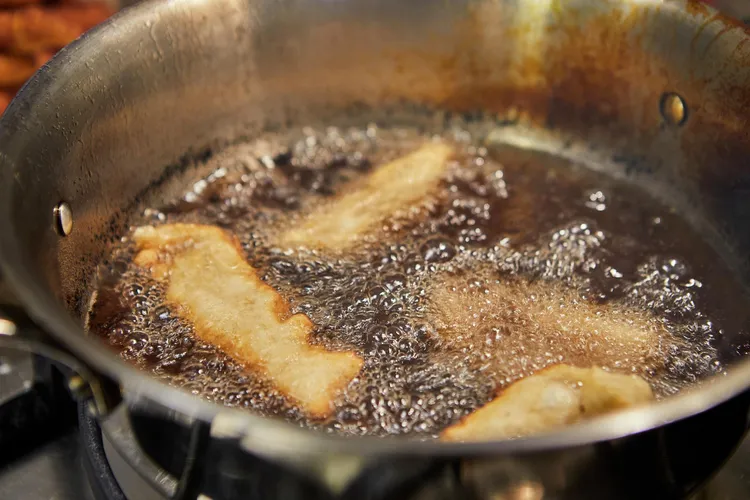
When food is submerged in oil at the right temperature, the surface moisture vaporises almost instantly. This creates a barrier of steam between the food and the oil - the vigorous bubbling you see when food first enters the fryer. As long as that steam barrier is maintained, oil cannot penetrate the food. The food cooks from the outside in, steam cooking the interior while the heat transforms the exterior into a crisp, dry, Maillard-browned crust.
When frying works: The oil is hot enough to instantly vaporise surface moisture. The steam barrier holds. The exterior crisps and browns. The interior cooks gently. The result is light, crispy, not greasy.
When frying fails: The oil is not hot enough. The moisture doesn't vaporise fast enough. The steam barrier doesn't form. Oil penetrates the food before the crust can set. The result is greasy, soft, heavy - exactly what people fear.
The entire science of good frying is contained in those two paragraphs. Temperature is the controlling variable. Everything else supports getting the temperature right and keeping it there.
Part 1: The Oil
Choosing the Right Oil
Not all oils are equal for frying. The primary criterion is smoke point - the temperature at which the oil begins to break down, produce acrid smoke, and develop off-flavors. You need an oil with a smoke point comfortably above your frying temperature.
| Oil | Smoke Point | Flavor | Best For |
|---|---|---|---|
| Refined sunflower oil | 225°C | Neutral | All-purpose; best default choice |
| Refined vegetable oil | 220°C | Neutral | All-purpose; widely available |
| Refined peanut oil | 230°C | Very slight nuttiness | Asian recipes, churros |
| Refined coconut oil | 204°C | Slight coconut | Specific applications |
| Light olive oil | 210°C | Very mild | European dishes |
| Extra virgin olive oil | 160-190°C | Fruity, assertive | Not recommended for deep frying |
| Lard / beef tallow | 190-205°C | Rich, savory | Churros, traditional European |
| Butter | 150°C | Rich | Never for deep frying |
Our recommendation: Refined sunflower oil for almost everything. It is neutral in flavor (so it doesn't affect the dish), has a high smoke point, is widely available, and is affordable enough to use in the quantities deep frying requires. Peanut oil is a good upgrade for Asian recipes where its slight nuttiness is a bonus rather than an intrusion.
Never use extra virgin olive oil for deep frying. Its low smoke point and assertive flavor make it wrong for this application. Save it for dressings, finishing, and low-heat cooking.
How Much Oil
Enough to fully submerge the food - or as close to it as your pan allows. Under-filled pans mean you have to flip everything multiple times for even browning, which disrupts crusts and produces uneven results.
For a standard Dutch oven (5-6 litre capacity), fill to approximately one-third - about 1.5-2 litres of oil. This provides enough depth (approximately 8-10cm) to submerge most street food items completely.
The one-third rule: Never fill a frying vessel more than one-third with oil. Oil expands and bubbles vigorously when food is added - a pan too full is a serious safety hazard.
Reusing Oil
Good news: frying oil can be reused 3-5 times if treated properly.
After frying, allow the oil to cool completely. Strain through a fine mesh sieve lined with a paper towel to remove food particles (which, if left in the oil, break down and lower the smoke point significantly). Store in a sealed container at room temperature for up to a month.
Discard the oil when: It darkens significantly, smells rancid or sharp, produces excessive smoke at normal frying temperatures, or develops a thick, syrupy texture. Any of these indicates the oil has broken down beyond use.
Part 2: The Temperature
Temperature is not just important - it is the entire difference between good frying and bad frying. If you take one thing from this guide, let it be this: buy a thermometer and use it every time.
Frying Temperatures by Food Type
Different foods require different temperatures. The variables are moisture content (higher moisture = lower temperature needed, more time), coating thickness (thicker coatings need slightly lower temp to cook through), and size of the item.
| Food | Temperature | Why |
|---|---|---|
| Arancini | 170-175°C | Thick coating needs to cook through without burning |
| Coxinha | 175-180°C | Dense dough exterior; needs medium-high heat |
| Pani puri shells | 165-170°C | Delicate semolina; too hot and they burn instantly |
| Churros | 175-180°C | Choux-based; needs immediate crust for structure |
| Chips / fries | 160°C (blanch) + 190°C (finish) | Double fry for crispy interior |
| Spanish croquetas | 180°C | Thin coating; quick fry only |
| Tempura / light batters | 175°C | Light batter; high temp for instant crunch |
How to Know the Temperature Without a Thermometer
A thermometer is the correct answer. But if you don't have one:
The wooden chopstick test: Dip the tip of a dry wooden chopstick into the oil. At 160°C, small, gentle bubbles form around it. At 170-175°C, steady, moderately active bubbles. At 180°C+, vigorous, rapid bubbles.
The bread cube test: Drop a 1cm cube of white bread into the oil. At 160°C it takes about 60 seconds to turn golden. At 170°C, about 40 seconds. At 180°C, about 30 seconds.
The water drop test: Flick a tiny drop of water from your fingertips into the oil from a safe distance. A gentle sizzle indicates medium heat; a vigorous, immediate reaction indicates 170°C+.
These are approximations. A thermometer costs £8-£15 and removes all guesswork permanently. It is the single best investment in your frying practice.
Managing Temperature During Frying
The most common frying problem is temperature drop. When cold food enters hot oil, the temperature drops immediately - sometimes by 10-20°C. If you add too much food at once, the temperature drops too far, the steam barrier fails, and everything becomes greasy.
The solution: Fry in small batches. Specifically: never fill more than one-third of the oil's surface area with food at any one time. Between batches, allow the oil to return to the target temperature before adding the next batch - this takes 1-2 minutes on a medium-high burner.
Watch the thermometer throughout, not just at the start. Adjust the burner to maintain temperature as you cook.
Part 3: The Equipment
The Fryer
You do not need a dedicated deep fryer. A Dutch oven (cast iron or enameled) is the best home frying vessel - it is heavy enough to maintain temperature through the shock of cold food, deep enough to safely contain oil and bubbles, and conducts heat evenly.
A deep, heavy-based saucepan works well. A wide, shallow pan is less ideal - more surface area means more oil required and more temperature fluctuation.
What to avoid: Thin-walled pans (temperature drops too fast), very wide pans (require too much oil), non-stick coatings at frying temperatures (non-stick degrades above 200°C).
The Thermometer
An instant-read digital thermometer or a clip-on probe thermometer (which attaches to the side of the pan and gives continuous readings) are both excellent. Clip-on probes are ideal for frying because they monitor temperature hands-free throughout the process.
Budget: £8-£25 for a reliable model. Worth every penny.
The Spider or Slotted Spoon
A spider - the flat, wide wire mesh skimmer used in Asian cooking - is the ideal tool for lowering food into oil, turning it, and lifting it out. It disturbs the oil less than tongs, allows oil to drain immediately, and handles fragile items (like pani puri shells) without crushing them.
A slotted spoon works. Tongs work for some items. The spider is the professional choice and costs £5-£10.
The Draining Setup
Fried food needs to drain immediately as it comes out of the oil. The standard setup: a wire rack placed over a baking tray lined with paper towels. The wire rack is important - placing fried food directly on paper towels traps steam underneath, which softens the bottom crust. The rack allows air circulation on all sides.
A Lid Nearby
Keep a lid for your frying vessel nearby at all times. In the unlikely event of an oil fire, cover the pan immediately with the lid - this cuts off oxygen and extinguishes the fire. Never use water on a hot oil fire.
Part 4: The Technique
Preparation: Dry the Food
Moisture is the enemy of good frying. Any surface moisture on food entering hot oil will cause violent spattering - a safety hazard - and premature crust softening. Pat proteins dry with paper towels before coating. Ensure coated items (arancini, coxinha) have a completely sealed, dry exterior before frying.
The one exception: Batter-dipped items (tempura, churros choux) go into the oil wet because the batter itself is the coating that will crisp.
The Coating System
Most fried street food uses a three-stage coating: flour, egg wash, breadcrumb or batter. Each stage serves a specific purpose.
Flour (first stage): Creates a dry surface that the egg wash can adhere to. Without flour, egg wash slides off. Use plain flour or rice flour (rice flour produces a lighter, crispier crust - preferred for Asian applications).
Egg wash (second stage): The adhesive that holds the outer coating to the food. Beat eggs with a small amount of milk or water - this thins the wash and creates a more even coating than neat egg.
Breadcrumb / batter (third stage): The crust itself. Fine dried breadcrumbs (panko or standard) for arancini and coxinha. Semolina for pani puri. Choux batter for churros.
Press the coating firmly. The most common coating failure is insufficient adhesion - the breadcrumbs lift during frying, creating bare patches where the filling is exposed to oil. Press the coating firmly onto the food and allow it to dry on a rack for 10 minutes before frying.
Lowering Food Into the Oil
Never drop food into hot oil from height - the splash is dangerous and disturbs the oil surface. Lower food in slowly using a spider or slotted spoon, releasing it gently once it's partially submerged. The initial contact produces vigorous bubbling - this is normal and expected.
For items that are likely to stick to the bottom (arancini, coxinha), lower gently and then immediately nudge them with the spider to prevent sticking. After about 30 seconds a crust will have formed and they will release on their own.
Turning
Most round or regularly shaped items (arancini, coxinha, pani puri shells) should be turned gently every 60-90 seconds for even browning. Flat items (fritters, socca-style preparations) are turned once.
Don't over-turn. Each turn disturbs the crust formation. Turn only when the underside is visibly golden - not every 15 seconds.
Reading Doneness
Color is the primary visual indicator: deep golden brown means correctly fried. Pale golden means under-fried (internal temperature may not be reached). Dark brown or black means over-fried (bitter, acrid flavor).
The sound test: Well-fried food has a specific sound when tapped with a spoon or spider - a hollow, light knock rather than a dense thud. This is most useful for items with thick coatings (arancini, coxinha).
The internal temperature: For filled items with protein (arancini with meat ragù, coxinha), the internal temperature should reach at least 75°C. Use your thermometer.
Draining and Holding
Place fried food immediately on the wire rack - never on paper towels directly. Season with fine sea salt immediately while still hot - salt adheres best to the surface of very hot food and doesn't adhere nearly as well once it cools.
Holding fried food: Fried food is at its absolute best within 2-3 minutes of leaving the oil. After that, steam from the interior begins to soften the crust. If you need to hold it - for a batch where you're frying multiple rounds - keep it on the wire rack in an oven at 100°C (fan off). This keeps the food hot without further cooking and maintains the crust for up to 20 minutes.
Part 5: Safety
This is the section that makes people nervous, which is exactly why it needs to be direct and specific.
The real risks of home frying are two: burns from spattering oil, and oil fires. Both are preventable with basic precautions.
Burns from spattering:
- Dry food thoroughly before it enters the oil
- Lower food slowly, never drop from height
- Keep children and pets out of the kitchen during frying
- Use long-handled tools - a spider with a long handle keeps your hands away from the oil surface
- Wear an apron - oil splashes are hot but not dangerous if they hit clothing; they are more dangerous on bare skin
Oil fires:
- Never fill more than one-third of the pan with oil
- Never leave hot oil unattended
- Keep a pan lid nearby at all times
- If the oil begins to smoke significantly, turn off the heat immediately - do not add food
- If an oil fire starts: Cover the pan with the lid immediately. Turn off the heat. Do not move the pan. Do not use water. The lid cuts off oxygen and extinguishes the fire in seconds.
- A fire blanket or dry powder fire extinguisher in the kitchen is advisable if you fry frequently
The smoke detector: Many home smoke detectors trigger from frying steam rather than actual smoke. Good ventilation - extractor fan on maximum, window open - prevents this and keeps the kitchen more comfortable during a frying session.
Part 6: Troubleshooting
The food is greasy and heavy. Oil temperature was too low. The steam barrier didn't form and oil absorbed into the food before a crust could set. Check your temperature before the next batch - it should be back at the target temperature after the previous batch cooled it.
The coating is falling off. The coating wasn't pressed firmly enough, or the food was wet when coated, or the coated items weren't allowed to rest and dry before frying. Also: check that each coating stage (flour, egg, breadcrumb) is applied thoroughly with no gaps.
The outside is dark but the inside is undercooked. Oil temperature too high - the outside browns before the heat penetrates to the centre. Reduce temperature by 10–15°C and fry for slightly longer.
The food is sticking to the bottom of the pan. The oil wasn't hot enough when the food was added - a crust hadn't formed quickly enough to prevent sticking. Bring the oil fully to temperature before adding any food, and nudge items immediately after they're submerged to prevent initial sticking.
Excessive spattering when food enters the oil. The food has surface moisture. Pat dry more thoroughly before frying. For items taken from the fridge, allow them to come to room temperature for 10-15 minutes before frying - very cold food also causes temperature drop and more violent spattering.
The oil smells burnt after frying. Food particles were left in the oil between batches. Skim the surface with the spider between each batch to remove debris. Strain the oil after the session before storing.
Applied: How This Guide Connects to Each Recipe
| Recipe | Temperature | Coating | Key Challenge | Post |
|---|---|---|---|---|
| Arancini | 170-175°C | Flour, egg, breadcrumb | Sealing the filling completely | → |
| Coxinha | 175-180°C | Egg, breadcrumb | Shaping and sealing the dough | → |
| Pani Puri shells | 165-170°C | None (self-blistering) | Achieving the hollow puff | → |
| Churros | 175-180°C | Choux batter | Piping consistent shape | → |
| Croquetas | 180°C | Flour, egg, breadcrumb | Keeping the béchamel cold | → |
FAQ
Q: Can I reuse frying oil and how many times?
Yes - up to 3-5 times if strained properly after each use and stored correctly. Strain through a fine sieve lined with a paper towel to remove all food particles. Discard when the oil darkens significantly, smells rancid, or produces excessive smoke at normal temperatures.
Q: Do I need a dedicated deep fryer?
No. A Dutch oven or deep heavy-based saucepan with a thermometer performs equally well for every recipe in this collection. Dedicated fryers are convenient but unnecessary. The Dutch oven has the advantage of being multipurpose.
Q: What's the best way to dispose of used frying oil?
Allow it to cool completely. Pour into a sealed container (the original bottle, or a jar) and dispose of it in general waste - never pour oil down the drain, where it solidifies and causes blockages. Many local councils and supermarkets have oil recycling facilities.
Q: My oil smokes immediately when I add food. What's wrong?
Either the oil has already degraded (discard and start with fresh oil), or the food is very wet (dry it thoroughly before frying). If the oil smokes before food is even added, the temperature has exceeded the smoke point - reduce the heat immediately.
Q: How do I know when arancini or coxinha are cooked through?
Color (deep golden brown), sound (hollow knock when tapped), and internal temperature (75°C for meat-filled items). For items with no raw protein in the filling (mushroom arancini, cheese-only fillings), color and the hollow sound are sufficient.
🔗 Use This Guide With
- The Perfect Arancini: Sicily's Greatest Street Food at Home
- Brazilian Coxinha: The Teardrop Croquette Everyone's Obsessed With
- Indian Pani Puri: The Street Food That Explodes in Your Mouth
- Spanish Street Food: 5 Recipes from the Markets of Madrid
- The Street Food Sauce Bible: 15 Sauces from 15 Countries
- Global Street Food at Home: The Ultimate Guide
Latest