The History of the Japanese Tea Ceremony
How a simple bowl of whipped tea became one of the world's most profound cultural practices
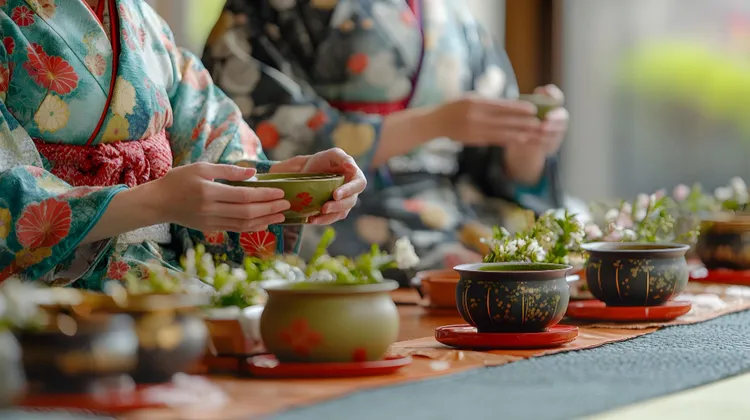
It begins with a bowl. A small, rough ceramic bowl, imperfect by design. Inside it: a pool of vivid green liquid, crowned with fine foam. The room is quiet. The garden outside is manicured but natural-looking. Every object has been chosen with care. Every movement has meaning.
This is Chado - the Way of Tea. And its story is one of the most remarkable cultural histories in the world.
Want to experience matcha the modern way first? See How to Whisk Matcha: The Perfect Cup Every Time - and then come back to understand the tradition it comes from.
Origins: Tea Comes to Japan (8th-12th Century)
Tea was not originally Japanese. Camellia sinensis originated in the Yunnan province of China, where it had been consumed for thousands of years - initially as a medicinal herb, later as a beverage.
Tea first came to Japan in the 8th century, brought by Buddhist monks and scholars who had traveled to Tang Dynasty China. These early travelers returned with tea plants and the practice of consuming powdered tea - a form called matcha - as part of religious ritual and meditation practice.
The first written record of tea in Japan dates to 815 CE, when Emperor Saga was offered tea by a Buddhist monk named Eichu. The emperor was so taken with it that he ordered tea cultivation in five provinces near Kyoto.
The Monk Who Changed Everything: Eisai (12th Century)
For several centuries after its introduction, tea remained confined to aristocratic and monastic circles. It was Zen Buddhist monk Myoan Eisai who transformed matcha from an aristocratic novelty into a cultural cornerstone.
Eisai traveled twice to Song Dynasty China (in 1168 and 1187), where he studied Zen Buddhism and observed the Chinese practice of consuming powdered tea during meditation. He returned to Japan in 1191 with tea seeds and a conviction that tea and Zen Buddhism belonged together.
In 1211, he wrote Kissa Yojoki ("How to Stay Healthy by Drinking Tea") - a text that described tea's health benefits and its relationship to spiritual practice. The book was one of the first to discuss the effects of L-theanine on calm focus, though obviously not by that name.
Eisai planted tea seeds at several locations including Uji, near Kyoto - establishing what would become the most prestigious tea-growing region in Japan.
The Rise of Tea Culture: Muromachi Period (14th-15th Century)
During the Muromachi Period, tea drinking spread rapidly through the samurai class. This era saw the emergence of toucha - competitive tea-tasting parties where participants attempted to distinguish high-quality Uji tea from lesser regional teas. These parties were elaborate, extravagant affairs, often involving gambling.
It was during this period that the aesthetic concept of wabi - finding beauty in simplicity, imperfection, and transience - began to influence tea culture. This was partly a reaction to the ostentatious tea parties of the wealthy, and partly an expression of Zen Buddhist philosophy.
The stage was being set for the most important figure in the history of Japanese tea.
Sen no Rikyu and the Perfection of Wabi-Cha (16th Century)
No single person shaped Japanese tea culture more profoundly than Sen no Rikyu (1522–1591). Under his influence, the tea ceremony was elevated from a social ritual to a complete aesthetic and philosophical practice.
Rikyu served as tea master to the two most powerful men of his era - warlords Oda Nobunaga and Toyotomi Hideyoshi. But his vision was radical: he insisted on stripping away the elaborate imported Chinese objects and theatrical excess that had come to dominate upper-class tea gatherings.
Instead, Rikyu advocated for wabi-cha: ceremony in a deliberately small, rough thatched hut (chashitsu), using deliberately imperfect, often locally-made ceramics, with an atmosphere of simplicity and mindfulness that made the act of sharing tea almost meditative.
His four principles of Chado remain the foundation of Japanese tea ceremony practice today:
- Wa (Harmony) - between host, guest, and environment
- Kei (Respect) - genuine respect between all present
- Sei (Purity) - physical and spiritual cleanliness
- Jaku (Tranquility) - the peace that arises from the other three
Tragically, Rikyu's story ended as dramatically as it began. After a conflict with Toyotomi Hideyoshi over a matter that historians still debate, he was ordered to commit ritual suicide (seppuku) in 1591. He died with the serene acceptance that his philosophy had always championed.
The Schools of Tea: Rikyu's Legacy (17th Century-Present)
After Rikyu's death, his three grandsons established the three main schools of Japanese tea ceremony that continue today:
- Urasenke - the most widely practiced school worldwide, slightly more approachable in style
- Omotesenke - emphasizes a more delicate, subtle form of the practice
- Mushakojisenke - the smallest school, known for a direct, spare aesthetic
Each school interprets Rikyu's teachings slightly differently, with distinct variations in technique, equipment preferences, and philosophy. Together they have kept Chado alive and evolving for over 400 years.
The Tea Ceremony Today
Far from being a museum piece, the Japanese tea ceremony remains a living practice. There are estimated to be several million practitioners worldwide, ranging from dedicated traditional students to people who attend a single tourist ceremony in Kyoto and carry something from it for the rest of their lives.
The physical setting - the chashitsu (tea room), the roji (garden path), the carefully chosen chakin (linen cloth) and natsume (tea caddy) - remains largely unchanged from Rikyu's time. The tools used to prepare and serve matcha carry centuries of refined design behind them.
What has changed is the context. Matcha has spread far beyond the tea room - into cafés, kitchens, and daily life worldwide.
But knowing this history makes every cup richer. When you whisk your matcha - even if it's in a modern kitchen with an electric frother - you're participating in a tradition that spans eight centuries and has shaped one of the world's great cultures.
🔗 Continue Exploring
Latest