Why Salt Matters in Bread Baking (And What Happens If You Skip It)
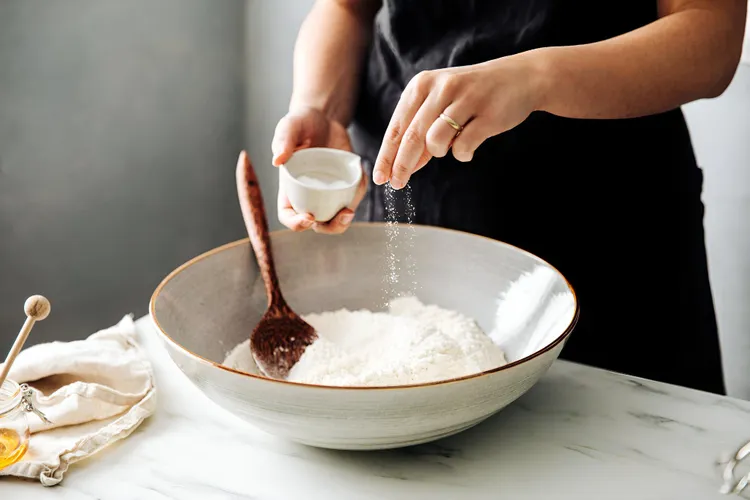
A baker once forgot salt in a batch of sourdough. The dough rose in 40 minutes flat, spread sideways in the oven, and produced a loaf that tasted - well, like warm cardboard. It was edible. Just barely.
Salt is the most underestimated ingredient in bread baking. Most beginners treat it as an afterthought - a pinch for flavor, easy to skip or eyeball. But salt is quietly doing three critical jobs in every loaf you bake, and when it's missing, every one of those jobs falls apart simultaneously.
Here's what salt actually does in bread baking, why it matters more than you think, and the precise amount that produces perfect results.
Salt's 3 Essential Jobs in Bread
Job 1: Flavor - The Obvious One
Let's get the obvious out of the way: salt makes bread taste like bread. An unsalted loaf has a flat, starchy, one-dimensional flavor. It's not just that it tastes bland - it actively tastes wrong. Your brain expects the contrast and complexity that salt provides, and without it, even a beautiful crumb feels hollow.
Salt also suppresses bitterness and amplifies all the other aromatic compounds developing during fermentation. The complex, wheaty depth of a good loaf? Salt is amplifying every note of it.
Job 2: Gluten Strengthening
This one surprises most beginners. Salt physically strengthens gluten - the protein network that gives bread its structure.
When salt dissolves in the dough, it tightens the bonds between gluten proteins, making the network more organized, more elastic, and more resistant to over-stretching. The result is dough that holds its shape better, rises more predictably, and produces a loaf with better texture and chew.
Without salt, gluten is weaker and more slack. The dough tends to be stickier, harder to shape, and more likely to spread rather than rise.
Tip: This is why shaping unsalted dough feels different - almost gummy and uncooperative. The gluten just isn't as strong without it.
Job 3: Fermentation Control
This is salt's most technically important role: it regulates yeast activity.
Yeast, if left completely unchecked, will ferment as fast as the temperature allows - consuming sugars rapidly, producing excess gas, and burning through the available food before proper flavor can develop. Salt slows this process down by drawing water away from yeast cells through osmosis, moderating their activity.
This controlled fermentation is what gives bread its flavor complexity. Long, steady fermentation produces organic acids, esters, and aromatic compounds that make a loaf interesting. Fast, unchecked fermentation produces a flat, yeasty taste and a coarse, uneven crumb.
Salt is essentially the pacing mechanism for your entire fermentation.
What Happens If You Skip Salt?
The effects are immediate and cascading:
The dough ferments too fast. Without salt's moderating effect, yeast runs wild. Dough that should take 2 hours may double in 45 minutes. This sounds good - who doesn't want faster bread? - but rapid fermentation skips the slow flavor development that makes bread delicious.
The gluten weakens. Without salt's strengthening effect, the gluten network is slacker and more extensible. The dough spreads rather than rising upward, and the loaf often bakes flatter than intended.
The crust suffers. Salt contributes to crust color development by affecting how sugars caramelize in the oven. Unsalted loaves often bake paler and don't develop that deep mahogany color on the crust.
The flavor is genuinely unpleasant. Not just bland - actively wrong. Unsalted bread has a raw, floury quality that doesn't resolve no matter how long you bake it.
How Much Salt Should You Use?
The professional baker's answer: 1.8-2% of flour weight. This is called baker's percentage, and it's the most reliable way to think about salt in any bread recipe.
| Flour Weight | Salt (1.8%) | Salt (2%) | Approximate Teaspoons |
|---|---|---|---|
| 300g | 5.4g | 6g | ~1 tsp |
| 400g | 7.2g | 8g | ~1¼ tsp |
| 500g | 9g | 10g | ~1½ tsp |
| 600g | 10.8g | 12g | ~2 tsp |
These numbers hold true across virtually every bread recipe - sourdough, sandwich loaves, focaccia, flatbreads. When a recipe falls outside this range, it's usually intentional (some rustic Italian breads traditionally use very little salt; some enriched doughs use more).
Common Mistake: Using table salt and kosher salt interchangeably by volume. They're very different by weight. Table salt is finer and packs more densely - 1 teaspoon of table salt weighs significantly more than 1 teaspoon of kosher salt. Always weigh your salt rather than measuring by volume for consistent results.
Does the Type of Salt Matter?
For bread baking, the salt type matters less than you'd think - as long as you're weighing it.
Fine sea salt is the most commonly recommended. It dissolves evenly and quickly into dough, distributing uniformly throughout.
Table salt works perfectly well and is what most home bakers already have. It's fine-grained and dissolves easily.
Kosher salt works but has a lower density than fine salt - so if you're measuring by volume (cups/teaspoons), you'll need about 25% more kosher salt to achieve the same salinity as table salt. By weight, it behaves identically.
Flaky sea salt (Maldon, fleur de sel): Excellent as a finishing salt pressed into the top of focaccia or flatbreads before baking - not ideal as a mixing salt because it doesn't dissolve as evenly.
When to Add Salt: Timing Matters
Salt inhibits yeast in high concentrations, so how and when you add it matters for certain methods.
For most hand-mixed doughs: Add salt with the dry ingredients. By the time everything is combined with water, the salt is diluted enough that it won't damage the yeast.
For autolyse methods: In sourdough and some artisan recipes, flour and water are mixed first and left to rest 20-60 minutes (autolyse) before salt is added. This gives gluten a head start developing before salt tightens the network.
Never: Pour salt directly onto a pile of dry yeast before mixing. In concentrated, undiluted form, salt can damage yeast cells. In any normal mixing scenario this isn't a real risk - but it's good practice to keep them separated until everything is combined.
Salt in Action: A Simple Comparison
Want to understand this firsthand? Try this experiment sometime:
Make a half-batch of your standard dough with full salt. Make another half-batch with no salt. Let both ferment side-by-side, same bowl size, same temperature.
Notice how much faster the unsalted dough rises. Feel how different it handles during shaping - stickier, harder to work with. After baking, compare the crust color and smell the two loaves before you taste them.
The difference is remarkably clear, and you'll never underestimate salt again.
Common Mistakes With Salt in Bread Baking
Mistake 1: Measuring by volume instead of weight. A teaspoon of fine sea salt and a teaspoon of Diamond Crystal kosher salt weigh very different amounts. Get a kitchen scale (covered in our 5 Essential Bread Baking Tools guide) and weigh your salt every time.
Mistake 2: Forgetting salt entirely. It happens - especially to beginners with a lot of steps to track. Add salt to your dry ingredients first, before adding water, so it's impossible to forget. Some bakers keep a small ramekin of pre-weighed salt next to the scale as a visual reminder.
Frequently Asked Questions
Q: Can I reduce salt for health reasons? You can reduce it slightly - down to about 1.5% - without catastrophic results. Below that, the gluten-weakening and fermentation-accelerating effects become noticeable. If you need a low-sodium diet, bread made with 1.5% salt is still meaningfully lower than most commercial loaves (which often exceed 2%).
Q: My bread tastes too salty - what happened? Check your salt type and measurement method. Fine table salt measured by volume will give you significantly more salt by weight than flaky kosher salt measured by the same volume. Switch to weighing. Also verify the recipe's percentage - some recipes, particularly enriched breads with butter and eggs, do call for slightly more salt to balance the richness.
Q: Does salt affect sourdough differently than commercial yeast? The principles are the same, but sourdough starters are more sensitive. In a long cold ferment, salt plays a crucial role in preventing the starter from becoming too acidic too quickly. Under-salted sourdough can develop an aggressively sour flavor from unregulated bacterial activity.
Q: Can I use flavored salts in bread? Yes - with care. Smoked salt, herb-infused salt, and similar products add interesting complexity. Just verify the salt concentration is similar to regular salt and account for any added flavors that might not complement the bread.
Q: Why do some Italian breads (like Tuscan pane sciocco) use no salt at all? It's tradition - and it works because those breads are specifically designed to accompany intensely salty, flavorful foods like cured meats, aged cheeses, and olive oil. The bread itself is neutral by design, meant to carry rather than compete with the food around it.
Salt Is Not Optional
At 1.8-2% of flour weight, salt sits in a sweet spot that strengthens gluten, controls fermentation, and produces the full, complex flavor that makes homemade bread worth baking. It's not a seasoning afterthought - it's a structural ingredient.
Get in the habit of weighing it, adding it consistently, and paying attention to when you add it relative to your yeast.
Then try the full technique in practice: our Complete Beginner's Guide to Baking Bread walks through exactly how salt fits into the mixing process, and the No-Knead Overnight Bread shows how salt's fermentation control plays out over a long, slow rise.
More from the Beginner's Bread Series:
Latest